

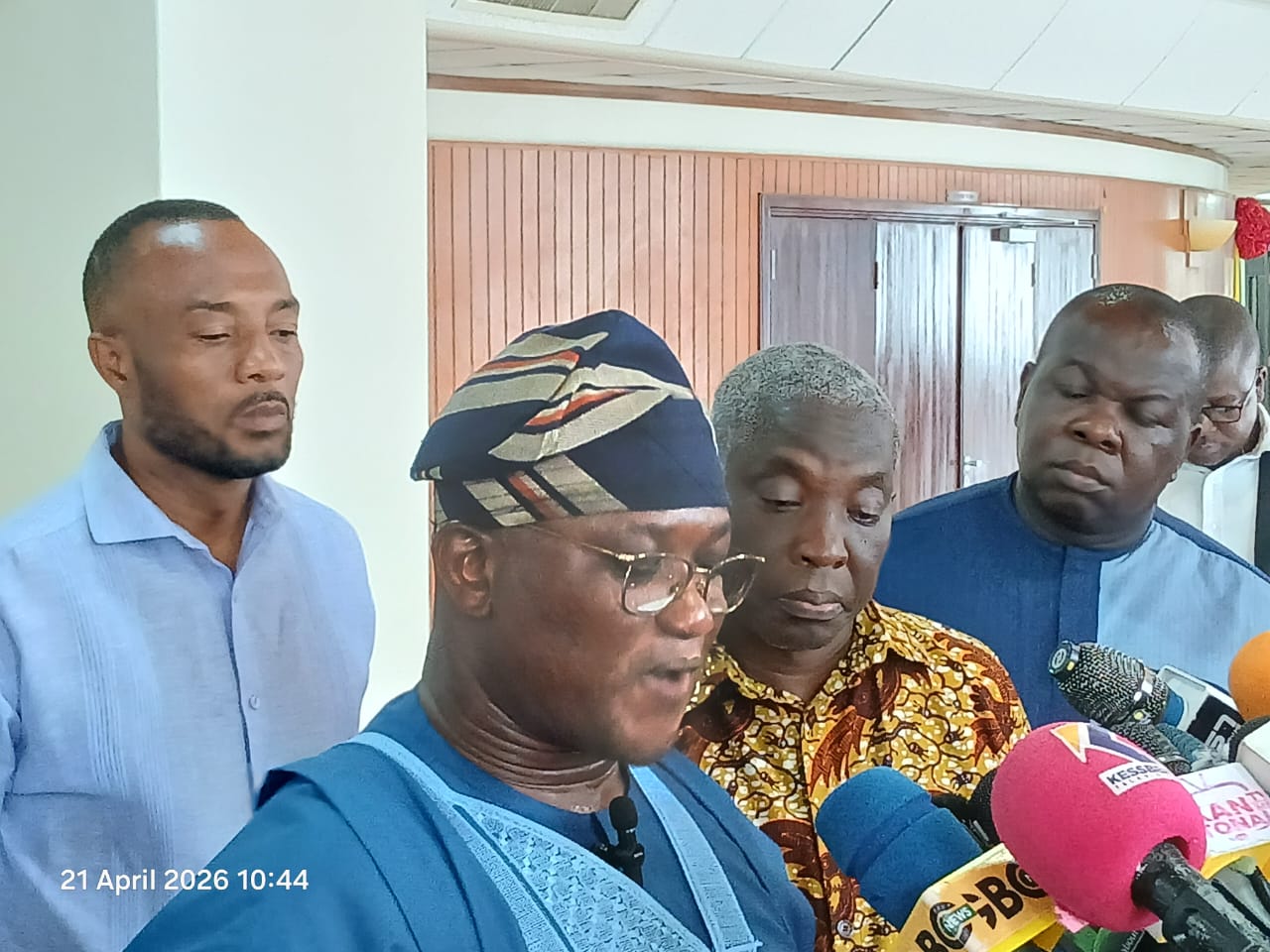
The NPP Minority Caucus in Parliament has raised serious concerns over what it described as a sustained and coordinated effort to undermine Ghana’s anti-corruption framework, particularly the Office of the Special Prosecutor (OSP), following the High Court ruling of 15 April 2026.
According to the Minority, the ruling is not an isolated judicial outcome, but part of a broader pattern of legislative, executive, and legal actions that collectively threaten the independence and survival of the OSP.
Systematic pressure on OSP
The Minority Caucus argued that recent developments represent a “multi-front campaign” aimed at weakening the OSP’s mandate and ultimately removing its ability to independently prosecute corruption cases.
Addressing a news conference in Parliament on Tuesday, April 21, 2026, the Deputy Ranking Member on Constitutional and Legal Affairs Committee of Parliament, Mr Alhassan Tampuli contended that the sequence of events, from attempted legislative repeal to multiple legal challenge, points to a deliberate strategy rather than coincidental institutional processes.
He maintained that Ghana’s anti-corruption architecture is being deliberately tested in ways that could reverse years of institutional reform.
Background
The Minority traced the beginning of the current tensions to December 2025, when private legal practitioner Martin Kpebu was briefly detained following a confrontation at the Office of the Special Prosecutor premises.
The incident, the Minorityt argud, quickly became politically amplified and was followed by calls for the removal of the Special Prosecutor.
Shortly thereafter, a legislative proposal was introduced in Parliament seeking the complete repeal of the Office of the Special Prosecutor Act.
Mr Tampuli who is also the Member of Parliament (MP) for Gushegu emphasised that this marked the first major institutional attempt to dismantle the office.
Failed repeal attempt and public backlash
The proposed repeal bill, according to the Minority, sought to dissolve the OSP and transfer its functions to the Attorney-General’s Department.
However, the group noted, “triggered widespread opposition from civil society organisations, governance advocates, and sections of the legal community. Following public debate and internal consultations, the bill was ultimately withdrawn.”
The Minority also maintained that although the bill was withdrawn, the intent behind it remained active and resurfaced through other legal and institutional channels.
Petitions and Supreme Court litigation
The Minority again pointed to multiple petitions filed under constitutional provisions seeking the removal of the Special Prosecutor.
According to the group, none of the petitions established a prima facie case when reviewed by the Chief Justice, effectively ending that avenue of challenge.
“Simultaneously, a constitutional case was filed at the Supreme Court questioning the legality of the OSP’s prosecutorial powers,” Mr Tampuli pointed out.
He expressed concern about the Attorney-General’s position in the case, arguing that the state’s legal representative has not robustly defended the institution’s mandate.
High Court ruling raises constitutional questions
The controversy intensified after a High Court ruling on 15 April 2026 declared that the OSP lacked constitutional authority to prosecute cases and ordered ongoing prosecutions transferred to the Attorney-General.
The Minority strongly disputed the ruling, arguing that it raises fundamental jurisdictional issues.
Mr Tampuli cited Article 130(1) of the 1992 Constitution, which grants the Supreme Court exclusive authority over constitutional interpretation, as the legal basis for their objection.
According to him, the High Court ruling risks creating legal uncertainty by making determinations that are already before the Supreme Court.
Minority’s position
The Minority argued that allowing the High Court decision to stand without challenge could undermine Ghana’s constitutional order and weaken independent accountability institutions.
Mr Tampuli maintained that the OSP remained legally established under Act 959 and that its mandate continues until the Supreme Court rules otherwise.
He cautioned that any attempt to curtail the OSP outside the Supreme Court’s determination would set a dangerous precedent for governance and the separation of powers.
Calls for action
The Minority is calling for:
- An immediate appeal and stay of execution of the High Court ruling
- Expedited hearing of the pending Supreme Court case on the OSP’s constitutional status
- Parliamentary scrutiny of the Attorney-General’s role in ongoing litigation
- Public clarification from the President on the government’s position regarding the OSP
A test of Ghana’s anti-corruption framework
The NPP Minority concluded that the unfolding developments represent a critical test of Ghana’s commitment to institutional independence and accountability.
The group argued that the OSP was created to operate beyond political influence and that any attempt to weaken its mandate risks reversing progress in the fight against corruption.
As legal proceedings continue, the Minority served notice it it will pursue all parliamentary and constitutional avenues to defend what it described as one of Ghana’s most important anti-corruption institutions.