
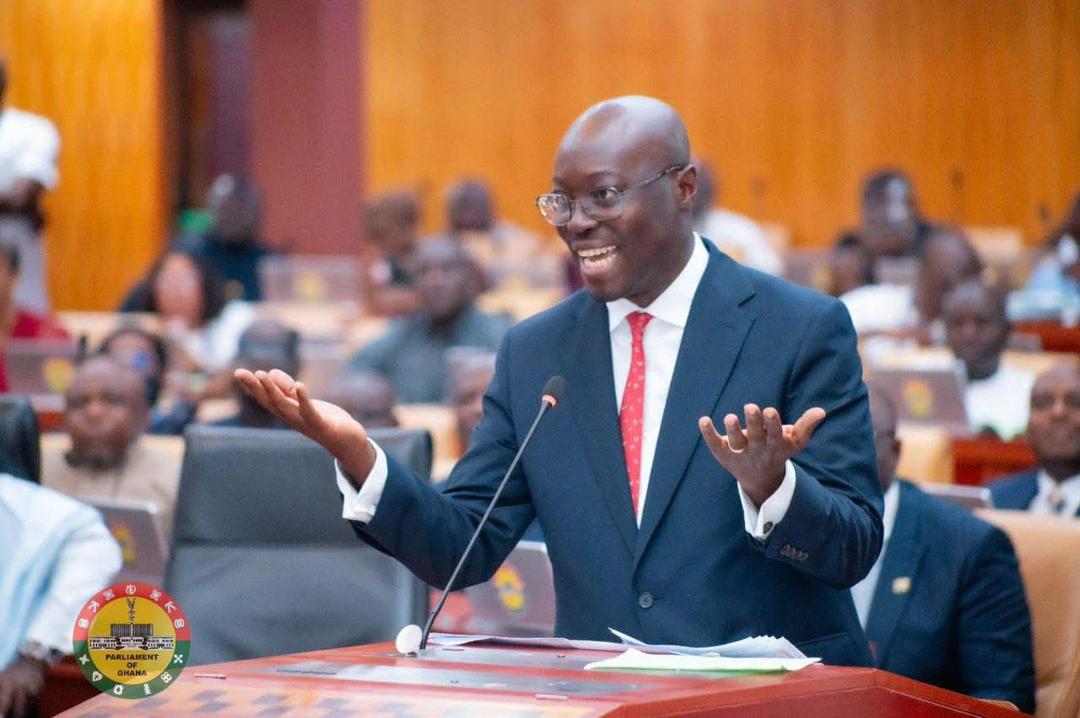
The Minister of Finance, Dr Cassiel Ato Forson, has given firm assurances that the government will not resort to additional borrowing to finance its proposed New Economy Programme. .
Instead, he insisted, the initiative will be funded entirely through domestic revenue mobilisation and savings generated from ongoing fiscal consolidation efforts.
Speaking during an interactive engagement with students and members of the university community at the Kwame Nkrumah University of Science and Technology (KNUST), Dr Ato Forson outlined a carefully calibrated plan that commits the equivalent of 1.5 per cent of Gross Domestic Product (GDP) each year between 2027 and 2030 without adding to Ghana’s public debt stock.
Addressing concerns about the sustainability and source of funding for the programme, the Minister explained that the required resources would be drawn from two complementary sources.
The first is a direct allocation of 0.5 per cent of GDP from government revenue. The second involves a deliberate adjustment to the primary surplus target, reducing it from the current 1.5 per cent of GDP to 0.5 per cent of GDP.
Together, these measures are expected to create the necessary fiscal space to support investments under the New Economy Programme. Over the four-year period, the combined allocation could reach at least US$13 billion, providing a substantial pool of resources for the government’s economic transformation agenda.
Dr Ato Forson was careful to clarify the role of the Ghana Gold Board (GoldBod) in the broader fiscal picture.
He stated unequivocally that GoldBod does not generate revenue for the Ministry of Finance or the central government.
The state’s finances, he emphasised, continue to rest primarily on the traditional pillars of direct taxes, indirect taxes and non-tax revenue.
This distinction was intended to dispel any misconception that proceeds from gold-related activities under the Board’s mandate form part of the regular revenue stream available for budgetary programmes such as the New Economy initiative.
On the question of debt sustainability, the Finance Minister reaffirmed the government’s commitment to its existing targets. Chief among these is the goal of reducing public debt to 45 per cent of GDP by 2028. He pointed to recent improvements in the country’s primary balance as concrete evidence of progress toward that objective.
Ghana recorded a primary surplus of 2.5 per cent of GDP in 2025, and a further surplus of 1.5 per cent of GDP is projected for 2026.
Taken together, these two successive surpluses are expected to contribute to a debt reduction equivalent to approximately 4 per cent of GDP.
Looking ahead, however, the government intends to moderate the pace of debt reduction from 2027 onwards. Rather than maintaining the more aggressive consolidation path, the primary surplus target will be eased to 0.5 per cent of GDP annually.
This measured slowdown is designed specifically to free up additional fiscal space that can be channelled into the New Economy Programme.
Dr Ato Forson stressed that the adjustment does not signal a departure from fiscal discipline. On the contrary, it represents a deliberate rebalancing that allows the government to invest in long-term economic transformation while still keeping public debt on a steadily declining trajectory.
The Minister framed the overall approach as one of responsible prioritisation. By relying on domestic resources and the efficiencies created through fiscal consolidation, the government aims to avoid the pitfalls of external borrowing that have historically constrained Ghana’s policy space.
The New Economy Programme, in this framing, becomes not an additional burden on the public purse but a carefully ring-fenced investment enabled by improved revenue performance and prudent management of the primary balance.
Throughout the engagement at KNUST, Dr Ato Forson returned repeatedly to the twin themes of credibility and continuity. The decision to fund the programme without new loans, he argued, reinforces the government’s broader narrative of restoring macroeconomic stability after years of elevated debt levels. .
At the same time, the willingness to recalibrate the pace of consolidation from 2027 demonstrates a pragmatic recognition that growth-oriented investments must accompany fiscal restraint if the economy is to deliver tangible improvements in living standards.
In summary, the Finance Minister presented a coherent and self-contained financing framework for the New Economy Programme. An annual commitment of 1.5 per cent of GDP between 2027 and 2030 will be met through a combination of direct revenue allocation and a moderated primary surplus target.
No additional loans will be contracted. GoldBod revenues will not form part of the funding base. Debt will continue to decline toward the 45 per cent of GDP target by 2028, albeit at a slightly slower rate after 2026 in order to accommodate productive public investment.
The approach, as articulated by Dr Ato Forson, seeks to reconcile the imperatives of fiscal sustainability with the equally pressing need for structural economic transformation.