
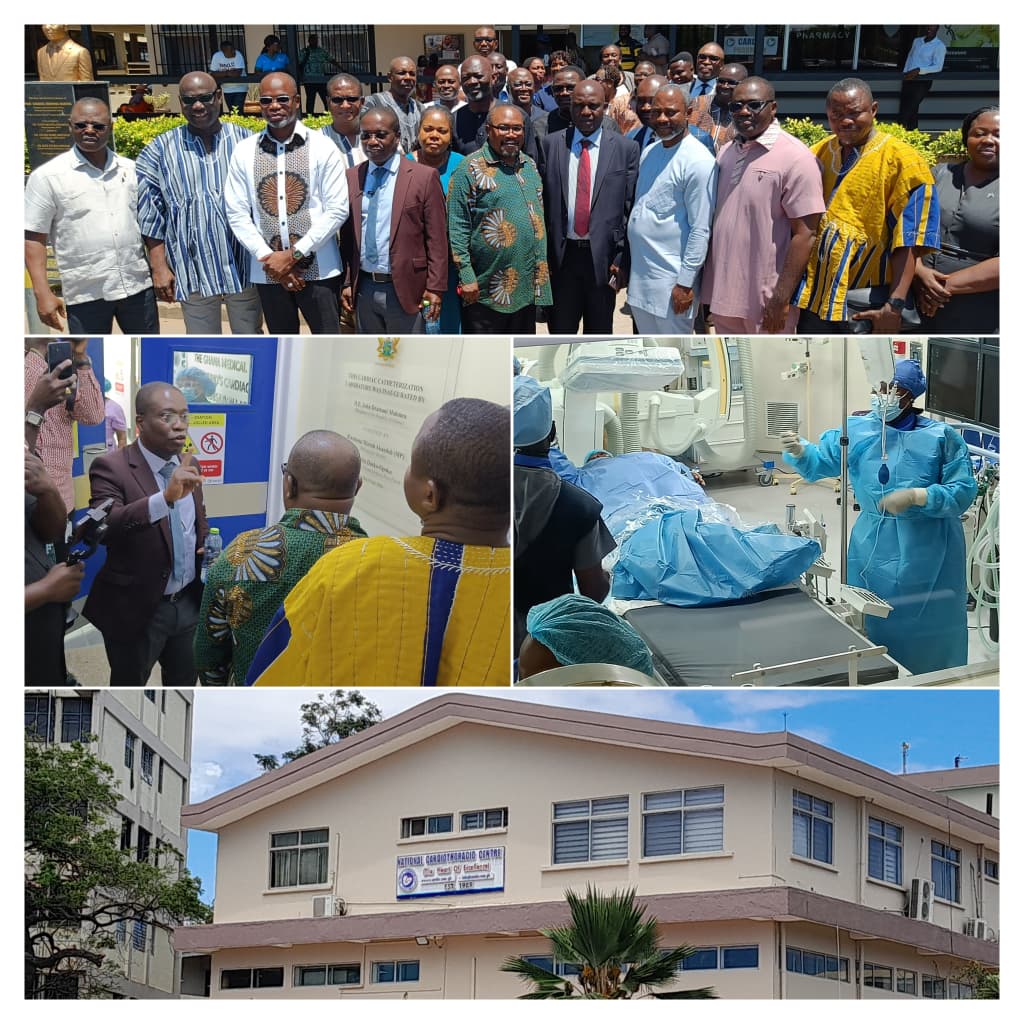
The Parliamentary Select Committee on Health has expressed profound satisfaction with the operations of the newly commissioned Cardiac Catheterisation Laboratory at the National Cardiothoracic Centre, Korle Bu Teaching Hospital, describing the facility as a game-changer in the country’s quest to provide specialised cardiovascular care.
The Committee, led by its Chairman, Dr Mark Kurt Nawaane, conducted an oversight visit to the facility to ascertain its functionality following its commissioning on July 9, 2026. The lab, provided through the Ghana Medical Trust Fund (Mahama Cares), is currently offering free cardiac interventions to patients.
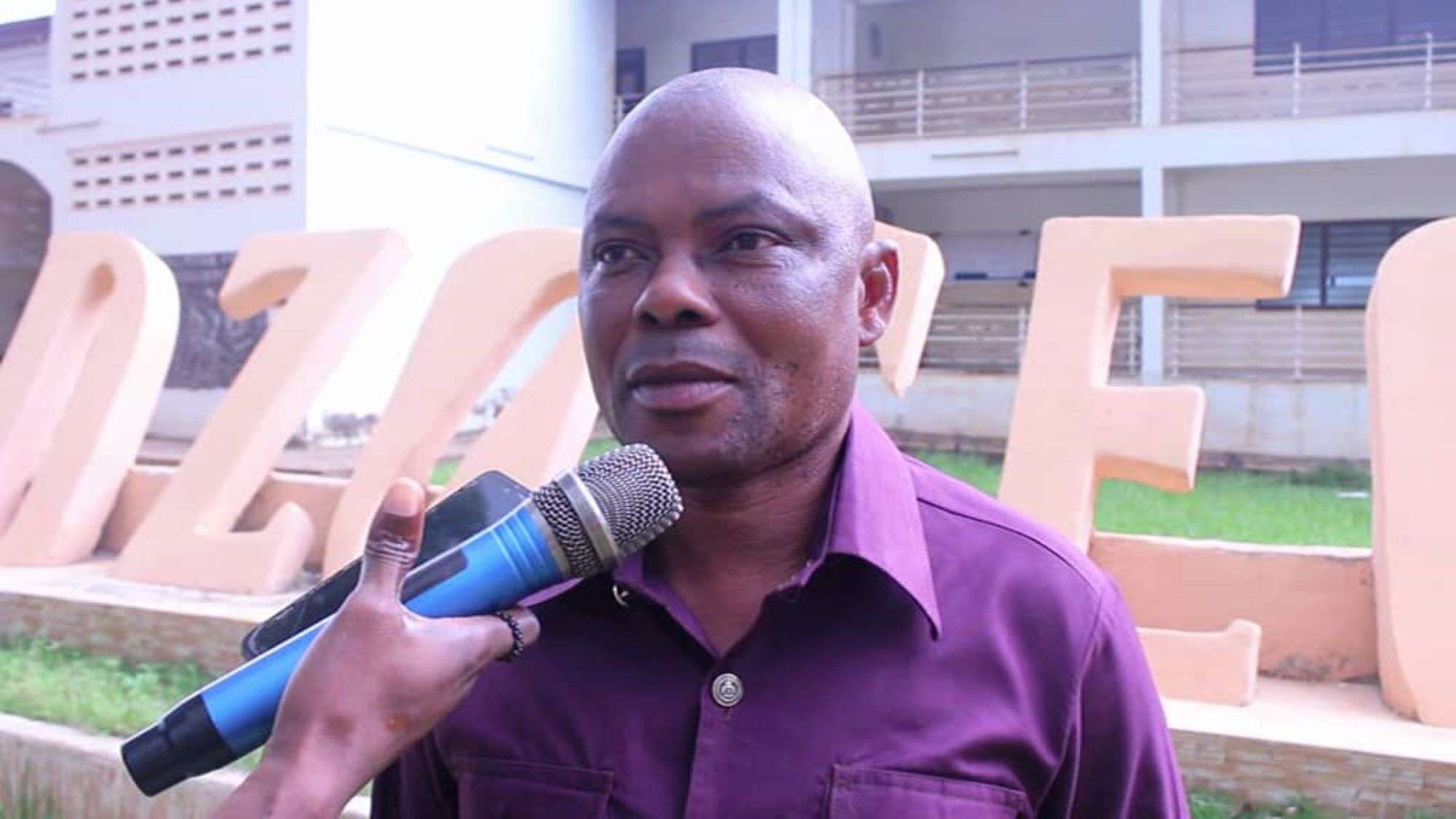
Speaking to the media after the tour, Dr. Nawaane, who is also the Member of Parliament for Nabdam, said the Committee was impressed to see patients undergoing procedures live at the facility at no cost.
“We are here today to visit the cardiothoracic unit, and specifically the Cath Lab Centre. When we went there, we saw everything live. There were patients there undergoing procedures, and all this is being done free of charge,” he stated. “The payment through the patient navigator is being taken over by the Ghana Medical Trust Fund (Mahama Cares). As a nation, we are doing very well.”
Dr. Nawaane lauded President John Dramani Mahama for his vision to make the project a legacy, noting that similar facilities under construction at the Komfo Anokye Teaching Hospital in Kumasi and the Tamale Teaching Hospital would soon be completed.
“I am hoping that very, very soon, no Ghanaian, and I repeat, no Ghanaian, will die because of the lack of a Cath Lab in this country. Emergency management is about time, and we are reducing the time it takes for a patient to get to a centre,” he added. He also commended the contractors for the timely execution of the projects, revealing that they are not owned by the government.
Operational Success
Providing technical details of the project, Mr. Abraham Fiscian, Project Manager for ADB Ghana Medical Systems Group, explained that the Korle Bu facility was a replacement for an existing one that got burnt. He noted that the space had to be re-engineered to accommodate the new equipment.
“Our works as of today have been completed. It was commissioned in July, and the facility is currently in operation,” Mr. Fiscian said. He added that a one-year maintenance agreement is in place, with the hospital expected to take over subsequently.
Training Concerns
While the facility’s infrastructure is state-of-the-art, the Deputy Ranking Member of the Committee, Dr. Patrick Boakye Yiadom, raised concerns about the human resource capacity. He noted that only one cardiac team is currently working at the centre, warning of burnout.
“They are working around the clock. They don’t have breaks. They can’t take leave. What happens if one of them falls sick?” the Obuasi East MP queried. He called on the government to prioritise the training of more skilled doctors and nurses to man the facility and the upcoming ones in Kumasi and Tamale.
Over 80 Patients Treated
Professor Titus Kofi Beyuo, Board Chairman of Korle Bu Teaching Hospital, disclosed that since the centre’s inception, over 80 Ghanaians, including more than 30 children, have benefited from complex cardiac procedures that were previously unavailable in the country.
He praised Africa World Airlines for transporting patients from the northern sector and the Ghana Medical Trust Fund for covering the cost of care.
“What is happening here is a sign of what Ghanaians can achieve,” Prof. Beyuo said. He made a passionate call for a flexible approach to training, suggesting that specialists be sent to high-volume centres abroad for hands-on experience. He noted that contrary to fears of brain drain, no cardiothoracic surgeon trained in Ghana has left the country.
Critical Need for Personnel
Dr. Kow Entsua-Mensah, Director of the National Cardiothoracic Centre, confirmed that the facility has been operating without any technical hitches since its commissioning. He revealed that the centre is not only treating heart conditions but also performing interventions for blood vessels in the brain and peripheral vascular disease.
However, he echoed the need for more staff to sustain the momentum. “The demand is great. It has become necessary to work throughout the day, evenings, and nights. Obviously, the staff will get tired. Our critical need is more personnel,” Dr. Entsua-Mensah stated, appealing to the government to recruit more cardiothoracic surgeons, anaesthetists, and critical care nurses to ensure 24/7 service delivery.
The visit concluded with a commitment from the Committee to advocate for the necessary resources to ensure the centre operates at full capacity.
By Kingsley Asiedu