

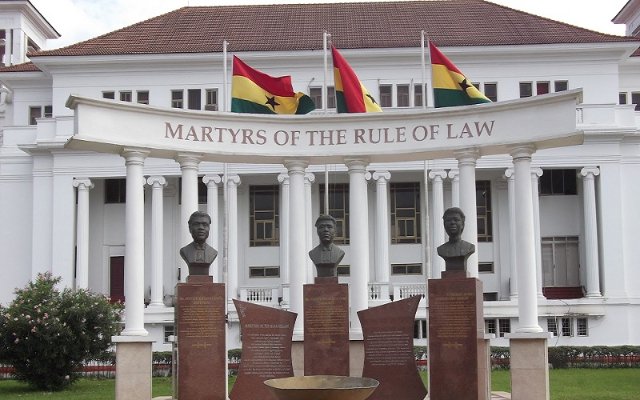
The Supreme Court of Ghana is set to confront a significant constitutional question: Does Article 66(2) of the 1992 Constitution impose a lifetime two-term limit on the presidency, or only a prohibition on consecutive terms?
Two separate writs filed in June 2026 by different plaintiffs seek declarations that could potentially open the door for former presidents who have served two non-consecutive terms to contest again.
The cases
1. Ganiwu Alhassan v Attorney-General Filed on or around June 26, 2026, by Ganiwu Alhassan, a citizen from Kpandai in the Northern Region, represented by Kwasi Afrifa Esq. of O & A Legal Consult, Kumasi.
Key Relief Sought: A declaration that a person who has served two separate and distinct terms (as opposed to two consecutive terms) as President is eligible to contest again. Any attempt to bar such a person would be unconstitutional.
2. Kenneth Kwabena Agyei Kuranchie v Attorney-General Filed on June 30, 2026, by Kenneth Kwabena Agyei Kuranchie of Achimota, Accra, represented by Bridget Brita Buabeng Esq. and Beatrice Buabeng Esq. of Besamho Legal Consult.
Key Reliefs Sought:
- The two-term limit applies only upon completion of two consecutive four-year terms.
- A substantial break (one full electoral cycle) resets the eligibility count.
- The prohibition in Article 66(2) is not triggered until a person has served two consecutive elected terms.
Both plaintiffs invoke the Supreme Court’s original jurisdiction under Articles 2(1) and 130(1)(a) of the Constitution.
Core constitutional argument
Article 66(2) of the 1992 Constitution states: “A person shall not be elected to hold office as President of Ghana for more than two terms.”
The plaintiffs argue for a purposive and contextual interpretation rather than a strict literal one. They contend that:
- The framers’ intention was to prevent perpetual or authoritarian rule (referencing Ghana’s pre-1992 history), not to impose a lifetime ban.
- The Constitution already contemplates partial terms (e.g., Article 60(6) & 60(7) regarding Vice-Presidents ascending to the presidency).
- Constitutional provisions must be read holistically, giving effect to the spirit of democracy, popular sovereignty, and the right of citizens to choose their leaders.
The cases cite numerous precedents on constitutional interpretation, including Tuffuor v Attorney-General, Sam (No. 2) v Attorney-General, and principles from Black’s Law Dictionary.
Potential implications
If the Supreme Court rules in favour of the plaintiffs’ interpretation, it could have far-reaching consequences for Ghanaian politics, potentially allowing former presidents (or those who served non-consecutive terms) to return after a break. This would be a landmark shift in the understanding of presidential term limits since the Fourth Republic began in 1992.
The Attorney-General has been served and is expected to file statements of case in response.
Political and legal context
These suits come at a time of active political discourse ahead of future elections. Term limits have generally been respected in Ghana’s young democracy, with peaceful transitions of power. However, debates about the exact scope of Article 66(2) have surfaced periodically.
Legal experts note that the Supreme Court has historically taken a robust approach to constitutional interpretation, balancing literal text with the broader objectives and values of the Constitution.
The Supreme Court is expected to schedule hearings on these matters. Given the constitutional significance, the cases may be heard together or attract interventions from interested parties, including political parties and civil society groups.
This development underscores the living nature of Ghana’s 1992 Constitution and the judiciary’s critical role as its final interpreter.