
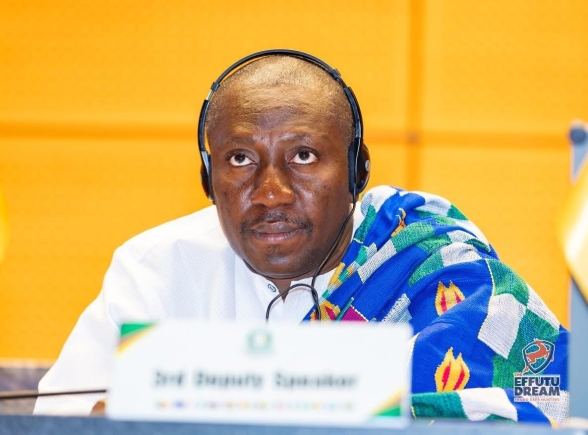
The Minority Leader and Third Deputy Speaker of the ECOWAS Parliament, Alexander Afenyo-Markin, has called on West African states to jointly push for the arrest and prosecution of individuals involved in xenophobic attacks against African nationals in South Africa, especially West Africans.
He insisted that South African authorities must take concrete action rather than issue statements, arguing that failure to prosecute perpetrators undermines both justice and Africa’s shared liberation history.
Addressing the ECOWAS Parliament in Abuja, Nigeria, he declared:
“South Africa must move from speeches to action. The South African Police Service, the National Prosecuting Authority and the Independent Police Investigative Directorate must investigate every documented incident. The perpetrators — many of whose faces are already known from social media — must be identified, arrested, charged and prosecuted without fear or favour . Not some of them. All of them.”
He also urged the regional parliament to escalate the matter diplomatically:
“I am asking this House to transmit a formal Statement of Deep Concern to the South African Parliament, the South African government, the African Union (AU) Commission, and the African Commission on Human and Peoples’ Rights, demanding arrests, prosecutions and convictions, and making clear that this Parliament will not accept the routine violation of the dignity and safety of West African nationals anywhere on this continent,” he said.
Mr Afenyo-Markin’s intervention, themed “West African lives, dignity and the imperative of integration: accountability, justice, free movement and regional solidarity”, highlighted repeated violent incidents targeting African migrants across South African cities.
He referenced President Cyril Ramaphosa’s Freedom Day remarks in Bloemfontein, noting both their condemnatory tone and their limitations in enforcement.
“Now, Madam Speaker, I want to address directly the intervention of President Cyril Ramaphosa in his keynote address at the 2026 Freedom Day National Celebrations in Bloemfontein on April 27. “He said, “We must not allow these concerns to give rise to xenophobia, directed towards people from other African countries or any other parts of the world. Instead, we must insist that the law be upheld and enforced. We will not allow people to take the law into their own hands.’”
He further cited: “’It cannot be, and it must never be, that we trample on the African fellowship that made our freedom possible.’”
Despite this, he argued that rhetoric alone cannot stop violence.
“Condemnations, however eloquent, do not bring a single attacker before a magistrate,” he said.
He also warned that framing migrants as conditional guests risks legitimising extremist interpretations of xenophobia.
Mr Afenyo-Markin concluded by linking the issue to broader regional insecurity, citing attacks on Ghanaian traders in Burkina Faso and rising instability in the Sahel.
He called for stronger ECOWAS protection systems for civilians in conflict zones and criticised gaps in the implementation of the ECOWAS free movement protocol, despite existing legal frameworks.