
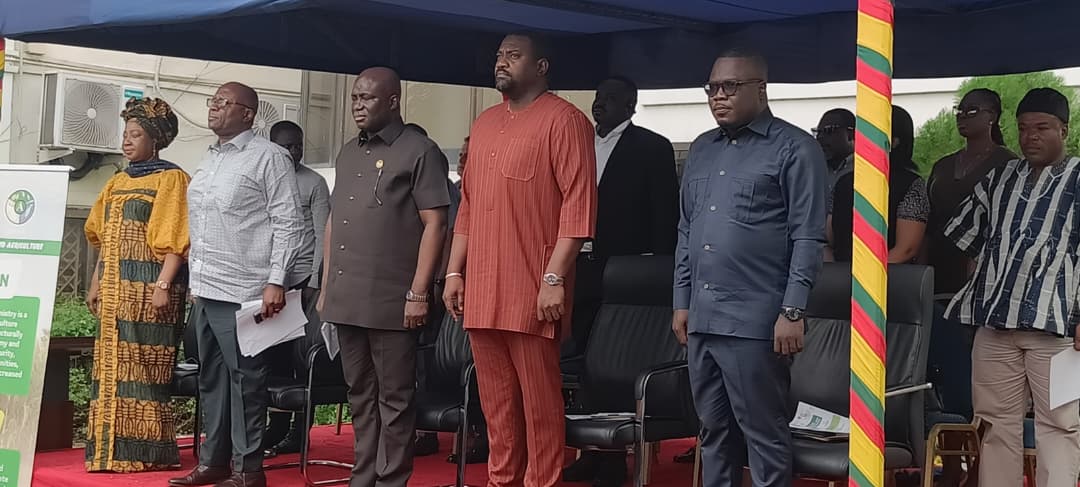
The Minister for Food and Agriculture, Mr. Eric Opoku, yesterday officially launched the 42nd National Farmers’ Day celebration at the forecourt of the Ministry of Food and Agriculture in Accra, with a clarion call on all Ghanaians to recognise and honour the nation’s farmers and fishers whose daily sacrifices sustain the country’s food systems and economy.
The launch, which was held under the theme “Our Farmers, Our Food, Our Future”, marks the beginning of preparations towards the main celebration scheduled for Friday, December 4, 2026, in Sunyani, the Bono Regional capital.
The event was attended by dignitaries from the agriculture sector, including the Chief Director of the Ministry of Fisheries and Aquaculture, Dr. Afisah Zakariah, who represented the Minister for Fisheries and Aquaculture, Hon.Emilia Arthur, and the Director General of the Ministry of Food and Agriculture, Mr. Paul Siameh.
In his keynote address, Hon. Opoku stated that the Farmers’ day is not merely ceremonial but a national call to honour the hands that feed Ghana. “It is a call to recognise the courage of our farmers, fishers, processors, extension officers, researchers, agribusinesses, and all actors whose daily sacrifices sustain our food systems and strengthen our economy,” he said.
He stressed that every grain of rice, tuber of yam, basket of tomato, crate of eggs, kilogram of fish, litre of milk, and cocoa pod is a product of labour, patience, risk, and hope. “Behind the food on our tables is a farmer who woke up before sunrise. Behind our markets is a fisher who faced the sea. Behind our agro-industry is a producer who believes that Ghana can feed itself and feed others,” the Minister added.
Agriculture remains foundation of development
Mr. Opoku emphasised that agriculture remains the foundation of Ghana’s development, feeding the people, employing the youth, providing raw materials for industry, earning foreign exchange, and supporting rural economies. “No country has achieved true transformation by neglecting agriculture. No nation can secure its future while depending helplessly on others for the food that it can produce,” he declared. He noted that under the vision of President John Dramani Mahama, the government is working to reposition agriculture as a modern, profitable, and job-creating enterprise, determined to make it attractive to the youth, rewarding to farmers, reliable for industry, and dependable for the nation.
The Minister explained that the theme “Our Farmers, Our Food, Our Future” is simple but powerful, reminding Ghanaians that the future of the country is tied to the strength of its farmers. “When we support the farmer, we secure our food. When we secure our food, we protect our people, and when we protect our people, we safeguard the future of our nation,” he said.
Sunyani to host 42nd celebration
Mr. Opoku formally announced that the 42nd National Farmers’ Day celebration would be hosted in Sunyani, Bono Region, describing the region as a proud agricultural zone with fertile lands, hardworking farmers, vibrant markets, and strong agricultural potential. “Sunyani is ready to welcome Ghana. Sunyani is ready to host our farmers. Sunyani is ready to showcase the best of Ghanaian agriculture,” he stated.
The celebration, which will be observed on the first Friday of December in accordance with the Public Holidays Act, will be preceded by a week-long programme of activities, including a five-day National Agricultural Fair from November 30 to December 4, 2026. The fair will provide a platform for exhibitors, agribusinesses, input dealers, research institutions, and financial institutions to showcase products, technologies, and innovations.
32 award categories to honour farmers
The Minister outlined that this year’s celebration would feature 32 substantive award categories at the national level, covering outstanding performance in crop production, livestock, poultry, fisheries, cocoa, coffee, shea, youth in agriculture, women in agriculture, persons with disability, agricultural extension, and research. Awards will also be presented at the regional and district levels to ensure that excellence is celebrated from the grassroots to the national stage.
Call for sponsorship and partnership
Mr. Opoku called on corporate Ghana, development partners, financial institutions, and the media to support the celebration, emphasising that sponsorship is not charity but an investment in Ghana’s food security, rural livelihoods, and job creation. “When you support National Farmers Day, you are not merely supporting an event, you are supporting the farmer who feeds your staff, your customers, your clients, and your communities,” he said.
Fisheries sector recognised
Dr. Afisah Zakariah, speaking on behalf of the Minister for Fisheries and Aquaculture, acknowledged the contributions of fishers, fish processors, traders, and canoe owners, stating that their daily efforts support livelihoods, provide nutrition, and contribute significantly to the national economy. “The future of agriculture and fisheries depends on innovation, sustainability, responsible resource management, and inclusive partnership,” she said.
Welcome address
Earlier, the Director General of the Ministry of Food and Agriculture, Mr. Paul Siameh, welcomed all guests and expressed appreciation for their participation. He noted that the successful organisation of National Farmers Day has always depended on strong partnerships and invited all stakeholders to support the noble course, stating that supporting the event is supporting food security, livelihoods, rural development, and the future of Ghana.
A national attitude
The Minister for Food and Agriculture concluded by urging that the theme must not end as a slogan but become a national attitude and a call to action. “A country that honours its farmers honours its future,” he said, before formally launching the 42nd National Farmers’ Day celebration on behalf of the President and the Government of Ghana.
The event ended with a call on all Ghanaians to respect the farmer, consume what Ghana produces, and support the nation’s drive towards food security and agricultural transformation.
By Kingsley Asiedu