
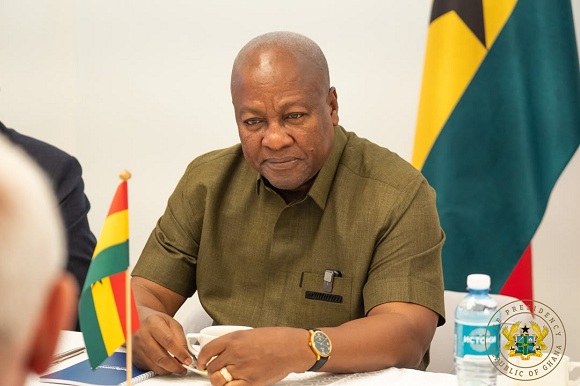
President John Dramani Mahama has reaffirmed his government’s commitment to boosting domestic revenue through improved tax collection and compliance rather than imposing new taxes.
Speaking during a courtesy call by the Kwahu Business Advocacy Group at the Jubilee House on Wednesday, July 8, 2026, the President said the government’s recent tax reforms are designed to ease the burden on Ghanaians while strengthening the efficiency of the country’s revenue mobilisation system.
He noted that the administration has already abolished several taxes that many Ghanaians considered burdensome, including the Electronic Transfer Levy (E-Levy) and the COVID-19 Health Recovery Levy, while efforts continue to simplify and rationalise the tax regime.
“We’ve removed some of the taxes that Ghanaians described as nuisance taxes. The COVID levy is gone, the E-Levy is gone, and we’re working to rationalise the other taxes. Overall, the indirect taxes, which are value-added taxes, have come down from 21 percent to 20 percent,” President Mahama said.
The President explained that the government’s immediate focus is on strengthening tax administration, improving compliance, and eliminating leakages in revenue collection instead of introducing additional taxes.
“Now, we’re concentrating on efficiency in collecting the taxes because we believe that if we collect the taxes more efficiently, we don’t need to introduce new taxes.
“What we’re concentrating on is efficiency in collecting the taxes, and I’m sure that if we collect the taxes more efficiently and the government is making more revenue, we can begin to bring down the incidence of tax and the burden on our people,” he stated.
President Mahama expressed confidence that sustained improvements in tax collection could eventually create fiscal space for further tax reductions, particularly for businesses.
He said that if the government’s revenue collection becomes significantly more efficient over the next two to three years, it would be possible to lower the corporate income tax rate, allowing businesses to retain more capital for expansion, investment, and job creation.
“I believe that in a few years—if in the next two or three years our efficiency in collecting taxes is improving—there is no reason why we can’t reduce the corporate income tax and bring it lower so that business people can be able to reinvest some of the money that they pay to the government,” he added.