
President John Dramani Mahama has unveiled a major low-cost housing initiative aimed at providing affordable and decent accommodation for public sector workers across the country.
According to the President, the initiative is being implemented through a partnership involving the government, organised labour, financial institutions, and the private sector to ensure that teachers, nurses, doctors, and other civil servants can own homes under flexible and affordable terms.
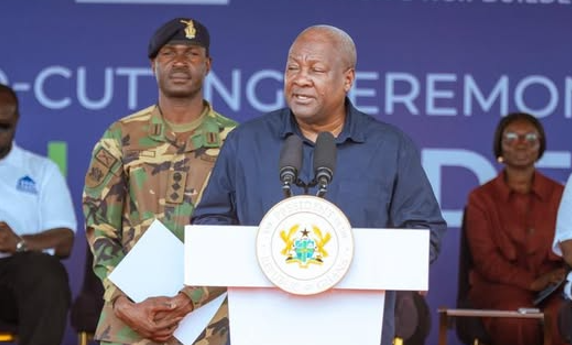
Mahama announced the policy on Saturday, May 9, 2026, during the sod-cutting ceremony for the construction of the over 1,000-unit Green City Housing Project at Dedesua in the Bosomtwe District of the Ashanti Region.
Speaking at the event, he explained that the programme is anchored on a new housing finance model, which includes the establishment of a GH¢3 billion revolving fund to support housing development nationwide.
The revolving fund, he said, will be created through a collaborative arrangement between the government, organised labour, the private sector, and major financial institutions.
Under the initiative, the Social Security and National Insurance Trust (SSNIT) and Republic Bank Ghana are expected to partner with labour unions and the government to operationalise the fund.
The financing facility will provide credit support to state-owned housing developers, including the State Housing Company (SHC) and the Tema Development Corporation (TDC), to accelerate the construction of affordable housing units across the country.
“Companies like State Housing Company (SHC), Tema Development Corporation (TDC), and all the housing companies will be given credit from this fund to build houses. The banks will then provide mortgages for workers to purchase the homes and repay over a 15 to 20-year period,” he said.
President Mahama noted that the arrangement is intended to make home ownership more accessible to public sector workers while strengthening Ghana’s housing delivery system through structured and sustainable financing.
He added that the initiative forms part of broader efforts to address Ghana’s housing deficit and improve living conditions for workers who continue to face challenges accessing affordable housing.