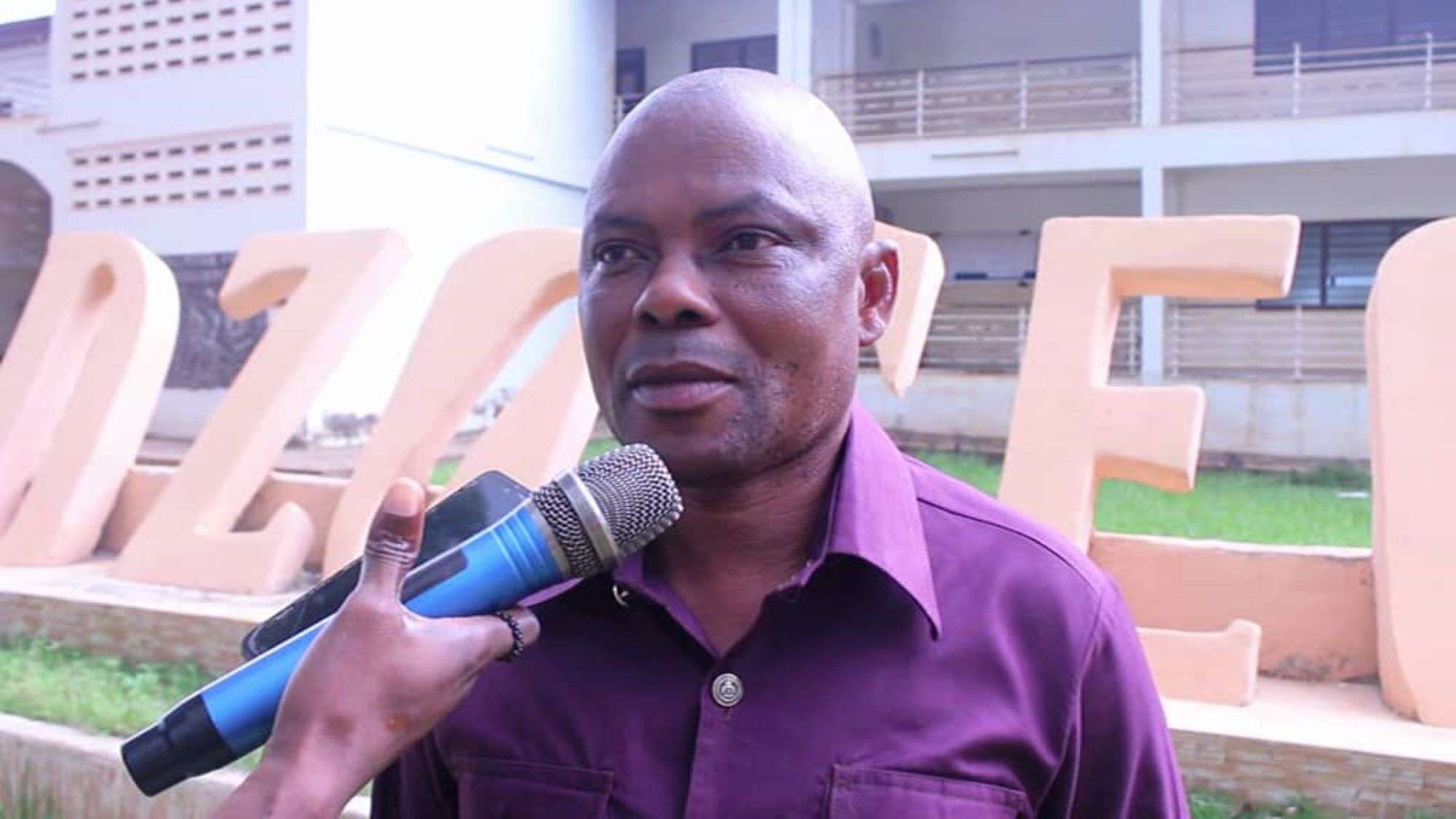

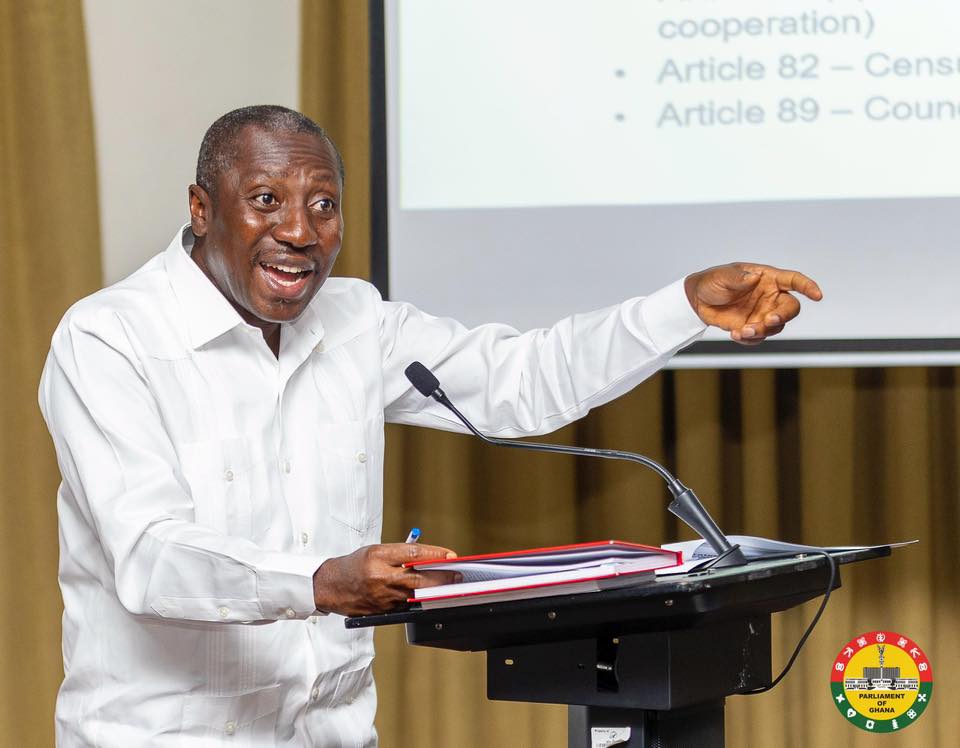
The vetting of Chief Justice nominee, Justice Paul Baffoe-Bonnie, took a dramatic twist as the Minority Leader, Osahen Alexander Afenyo-Markin, described the process as a breach of natural justice.
He argued strongly that Parliament could not go ahead to vet the CJ nominee when there were pending legal cases concerning what he termed the wrongful removal of Chief Justice Gertrude Araba Esaaba Sackey Torkornoo.
Delivering a blistering opening statement on Monday against the vetting, the Minority Leader argued that his side could not participate in a flawed process as legal challenges relating to the nomination of Justice Baffoe-Bonnie remained unresolved.
Osahen Afenyo-Markin emphasised the unshakable resolve of the Minority caucus to defend the country’s constitution, declaring the proceedings a “test of whether Ghana’s judiciary will remain independent or fall under executive and political control.”
The Minority registered its unequivocal objection and condemnation of the process, which Osahen Afenyo-Markin described as a “coordinated campaign to subjugate Ghana’s judiciary to political domination.”
At the core of the Minority’s concern is the controversial removal of Chief Justice Torkornoo on April 22, 2025, which the minority leader stated occurred under “fraudulent circumstances.”
He asserted that accountability demands due process and fairness for Justice Torkornoo, neither of which was adhered to.
The Minority Leader pointed out that seven separate proceedings across three jurisdictions, the Supreme Court, the High Court, and the ECOWAS Court of Justice, currently challenge the constitutional validity of Justice Torkornoo’s removal.
However, while these cases remained pending and the question of a vacancy remained subjudice, the Head of the Executive arm of government, President John Dramani, rushed to nominate a replacement.
According to Osahen Afenyo-Markin, the clarity was not the objective but rather the creation of a fait accompli (an irreversible fact).
He argued that Justice Baffoe-Bonnie could have continued serving in an acting chief justice capacity under Article 144(6) until the courts provided clarity, as there was no institutional crisis demanding urgent action.
The most severe accusation was pointed directly to the nominee, who was declared to be in a “manifest conflict of interest.”
Osahen Afenyo-Markin submitted that Justice Baffoe-Bonnie, as the Acting Chief Justice, “wields administrative power over proceedings that, if successful, would invalidate the very removal that elevated him.”
He also criticised the nominee for taking “no visible steps to compel the Attorney-General to defend Ghana’s interests” or schedule hearings for the cases challenging his own legitimacy.
The Minority Leader also launched a strong attack on the government’s principal legal officer, calling the conduct of the Attorney-General “scandalous” for not filing defenses in any of the seven court proceedings.
Osahen Afenyo-Markin labelled this failure as a deliberate “strategy” to allow the cases to “languish undefended,” thereby creating space for the rushed confirmation of the nominee to proceed, a strategy that risks “international humiliation” at the ECOWAS Court.
The Minority Leader confirmed that a motion they presented to Parliament to suspend the proceedings until the courts determined whether a vacancy for Chief Justice actually existed was refused by Speaker Alban Bagbin.
According to him, despite his distinguished career, the CJ nominee appeared before the committee as “the direct beneficiary of the very constitutional irregularities we are duty-bound to examine.”
The Minority Leader immediately followed his legal argument by leading his members on the Appointments Committee to stage a walkout, leaving only members of the Majority side to vet Justice Baffoe-Bonnie.
The walkout signalled a total boycott of the vetting process, effectively withdrawing the Minority’s participation from the questioning phase and rejecting the legitimacy of the proceedings outright.
This underscored the Minority’s unwavering position that the vetting was “constitutionally premature” and that they would not be “silent accomplices to this subversion.”