
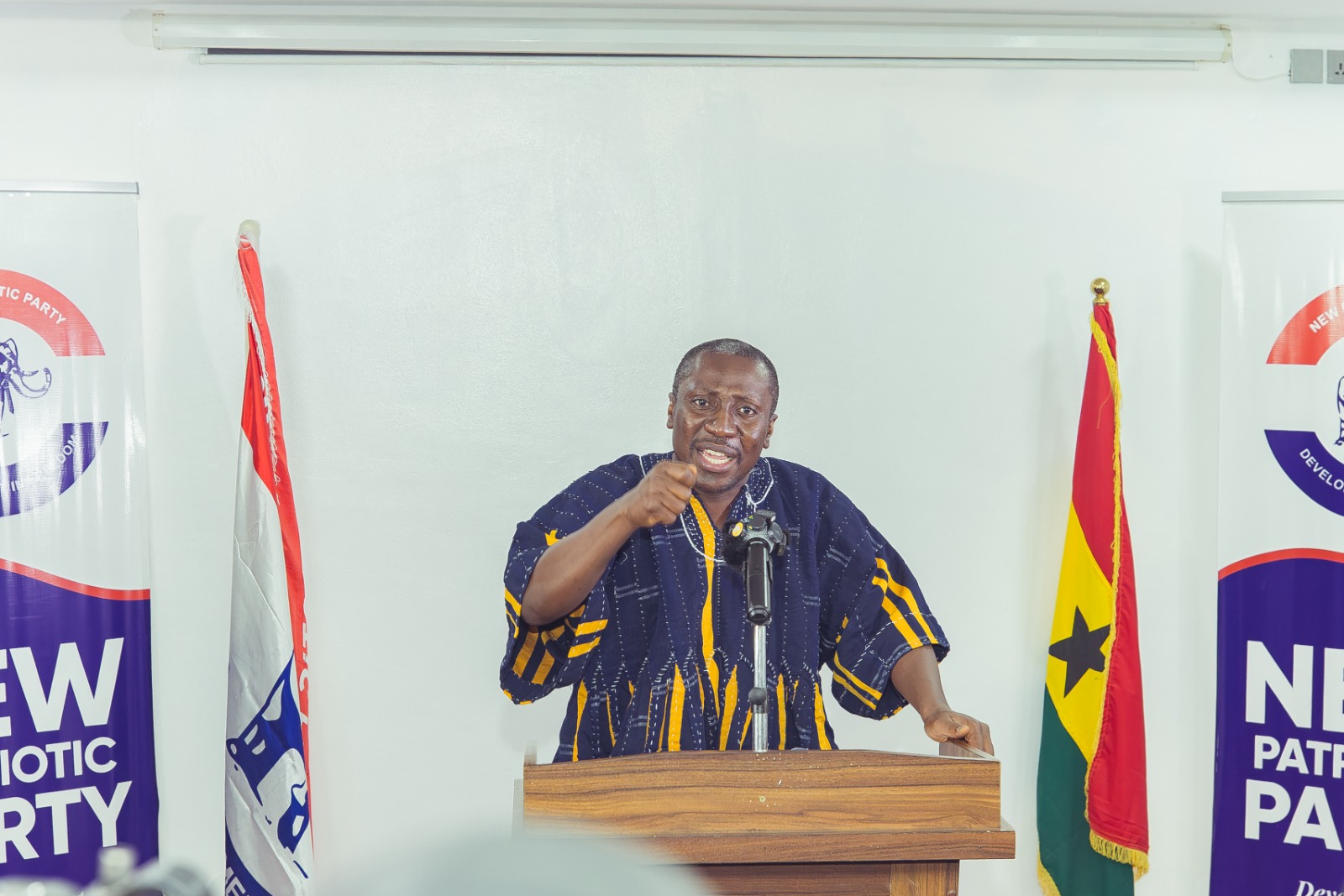
In a blistering attack on the governing National Democratic Congress (NDC), the New Patriotic Party (NPP) Minority Caucus in Parliament has accused the Mahama administration of hypocrisy, political deceit, and a fundamental breach of faith with the Ghanaian people over the controversial Human Sexual Rights and Family Values Bill, widely known as the anti-LGBTQI+ Bill.
In a hard-hitting statement issued on June 4, 2026, Minority Leader Osahen Alexander Kwamena Afenyo-Markin reiterated NPP’s unwavering opposition to the normalisation, promotion, or protection of LGBTQ+ values and practices in Ghana.
The main opposition NPP, the Minority Leader, is accordingly demanding the original Bill passed by the 8th Parliament, which President John Dramani Mahama pledged to assent to, be passed again in its unamended form and transmitted immediately for presidential approval.
This, the party argued, represented “the aspiration of the overwhelming majority of Ghanaians.”
Osahen Afenyo-Markin maintained this stance fully aligns with the cultural, religious, and moral convictions of the vast majority of Ghanaians.
The statement followed growing public scrutiny of the NDC government’s handling of the Bill that was dramatically altered after the party assumed power after the 2024 general election.
Consensus 2024 Parliament
According to the Minority Leader, the events of 2024 painted a clear picture of bipartisan consensus in passing the original Bill.
Both sides of the 8th Parliament, Osahen Afenyo-Markin noted, were convinced that the Bill reflected deeply held Ghanaian values and passed it unanimously after extensive debate.
He recalled that the then-opposition NDC played a particularly hardline role, fiercely resisting any attempts to amend even a single provision of the legislation.
Speaker of the 8th Parliament, Alban S.K. Bagbin, the Minority Leader added, led efforts to ensure the Bill passed without compromise or dilution.
“When the previous NPP administration hesitated to receive the Bill for assent due to ongoing court challenges regarding its constitutionality, the NDC launched strong public attacks, accusing the government of sympathising with LGBTQ+ causes”, Osahen Afenyo-Markin recounted.
He also reminded Ghanaians that the NDC weaponised the Anti-LGBTQI+ issue, mobilising religious leaders and urging voters to reject the NPP in the 2024 elections.
The NDC, he pointed out, promised that its victory in that general election would guarantee the Bill’s swift enactment into law.
“Having secured power on the strength of that position, Ghanaians are entitled to expect the John Mahama administration to honour, without equivocation, the commitments and representations made regarding the 2024 Bill that the 8th Parliament passed,” Osahen Afenyo-Markin said.
U-Turn under NDC government
The NPP Minority Caucus argued that the NDC has performed a shocking about-face since assuming office.
According to the Minority Leader, the re-introduced Private Members’ Bill has undergone 31 amendments, fundamentally altering key provisions that NDC MPs had previously fought to preserve in its original form.
Osahen Afenyo-Markin reiterated that this heavily revised version is a “clear departure” from the NDC’s 2024 position and a “fundamental breach of faith” with the Ghanaian people.
He labelled the reversal as both “strange and hypocritical,” accusing the NDC of political insincerity and deceit.
“These extensive amendments betray principle and expose the political insincerity of the NDC’s earlier posture,” he added.
The Minority Leader decried that these developments affirm that the NDC “cannot be trusted.”
He further pointed out the irony involving Speaker Bagbin himself.
“Though he did not personally preside over the passage of the original Bill, the same Speaker — now leading the 9th Parliament — has overseen the passage of a significantly watered-down version of the legislation he once vigorously championed,” Osahen Afenyo-Markin lamented.
Internal contradictions and delays
The Minority Caucus also highlighted deepening contradictions within the governing NDC. Following the passage of the amended Bill, President Mahama publicly suggested that Parliament may have lacked the requisite quorum.
In response, Speaker Bagbin called for the Bill to be returned to the floor for a fresh Consideration Stage, while the Majority Leader publicly disagreed with this position.
The NPP viewed these conflicting signals as a deliberate attempt to frustrate the Bill’s enactment while trying to manage the political fallout from abandoning a position the NDC once vigorously defended.
Further fuelling suspicions, President Mahama told an audience at Chatham House in London this week that his administration was in “no hurry” to see the Bill become law.
The Minority caucus said it has received reliable information that the President gave assurances to the British Prime Minister at No. 10 Downing Street, saying the Bill remains “far from becoming law.”
The group argued that such assurances represent a “remarkable departure” from the urgency the NDC displayed while in opposition and raise serious questions about the government’s consistency, credibility, and commitment to the issue.
“The issue before the country has never been whether or not Ghanaians support the values embodied in the 2024 Bill, the real issue is whether the NDC can be trusted,” Osahen Afenyo-Markin stated.
Likely political ramifications
This latest political firestorm is expected to significantly intensify public debate on one of the most emotionally and culturally charged issues in Ghana’s recent history.
The anti-LGBTQ+ Bill has long polarised opinions, with strong support from religious bodies, traditional authorities, and large segments of the population, while drawing criticism from human rights advocates and international partners.