

By Ken Bediako
Ohene Djan Ghana’s Sports administration supremo could not complete his 7th back to back national football league programme he started in 1958 because of the 1966 Military cum Police Coup d’etat that toppled the all powerful Dr Kwame Nkrumah’s government.
Ohene Djan actually started the league in March that year but subsequent events including his official dismissal from office in April caused a lot of confusion in the national sports scene.
Let me recall the full story of the 1966 League season that travelled from March 13 to December 16.
COUP D’ETAT DISRUPTS LEAGUE
The February 24 coup d’etat, which toppled the Kwame Nkrumah administration, delayed the start of the league. Republikans, dubbed ‘Osagyefo’s Own Club’ (OOC), was immediately dissolved and most of its star players returned to their mother clubs and others changed clubs. Black Stars players such as Addo Odametey and Ofei Dodoo returned to Hearts. Kofi Pare, Ben Acheampong and Franklin Crentsil signed for Asante Kotoko. Dodoo Ankrah, E. O. Oblitey and Jones Attuquayefio moved to Great Olympics.
Along with Republikans, Sekondi Independence was also dissolved. The club belonged to Ambrose Yankey who was Dr. Kwame Nkrumah’s personal aide. The other club that couldn’t compete was Defence Stars; a number of their players were soldiers in active service and had been involved in the February 24 coup d’etat.
Ohene Djan was removed from office on April 8 by the new military cum Police administration, National Liberation Council, and replaced by W.T. Marbell, a retired education officer and H.P. Nyemitei became the chairman of GFA.
A government statement said, “The Central Organisation of Sports (COS) is to be reorganized on a better and more democratic basis.”
Indeed, it was Ohene Djan who had earlier announced the dissolution of Republikans and Sekondi Independence.
He told a press conference in Accra that the mood of the country made it a national taboo for any football club to operate in Ghana “under the inglorious insignia of Osagyefo’s Own Club” as Republikans were affectionately called.
Interestingly, Ghana’s national team, made up predominantly of Republikans, had last won the cup of nations in 1965. After the dissolution of the team, it took 13 more years for Ghana to win the African cup again. That was in Ghana 1978 with a 2-0 win over Uganda in the Cup final at Accra stadium.
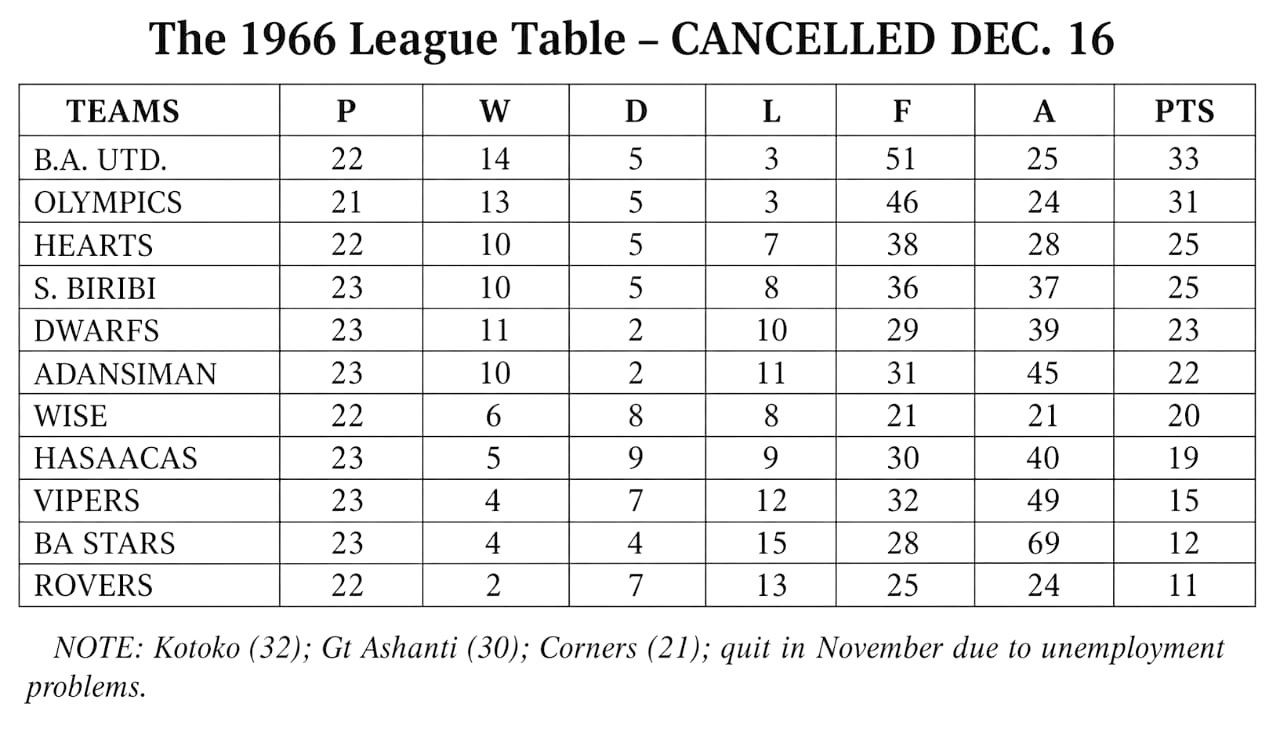
Fourteen clubs started the exciting league on March 13 but it was cancelled on December 15. The cancellation was sparked off by Asante Kotoko, Great Ashanti and Cornerstone who quit the league on November 29 due to “unemployment problems.”
Most of their players worked for state-owned organisations such as the Farmers Council and the Workers Brigade, and had been laid off in the wake of the political changes sweeping through the country.
Earlier, on November 23, a meeting had been held in Accra between the league clubs, GAFA and COS. To enable the clubs to get more revenue, the COS decided at the meeting to reduce its share of gate proceeds from 30 to 25 percent. They also reached a general consensus that clubs should submit the names of unemployed players to be sent to government for consideration.
The clubs, however, did not give the government enough time to respond to their demands. In a joint statement, the clubs said they were quitting the league until their dismissed players were re-instated at their companies of employment.
The boycott by the three Ashanti clubs disrupted the fixtures and only two matches were played the following week. Hearts beat Rovers 4-1 in Accra and Olympics beat Dwarfs 2-1 at Cape Coast.
In the midst of the authorities weighing the options available to solve the unemployment crisis that resulted in the teams quitting the league, a petition was lodged by four football clubs in the Northern and Upper Regions. Gbewa, Great Harmattans, Wait & See and Northern Stars accused the COS of ignoring the two regions in sporting activities. In their statement, signed by Abdulai Mahama, chairman of Wait & See, they rejected a previous argument of the authorities that the two regions were too far away and lacked proper roads.
On December 15, The Commissioner for Education and Sports, A. K. Deku called a meeting of the clubs, COS and GAFA and it was decided to cancel the league. The GAFA was tasked to arrange special friendly matches for the clubs until a programme for next season was drawn.
Problems plaguing the clubs and authorities notwithstanding, the season turned out to be an exciting but shortlived league with high scoring results. Highlights saw B. A. United beat Hasaacas 6-0 at Sunyani, Kotoko whipped Susu Biribi 7-1 and Rovers 8-0 both in Kumasi, Great Ashanti beat Adansiman 6-0 at Koforidua. B. A. Stars were the whipping boys losing 7-1 to B. A. United, 7-1 to Kotoko and 5-0 to Hearts. Other exciting matches saw Hasaacas beat Dwarfs 3-0 in Sekondi and Adansiman beat Hearts 3-0 at Obuasi.
The first round was extremely close, ending with Kotoko having 22 points and leading Olympics by only one point, followed by B. A. United with 20 points.
On September 1, the entire 40 registered players of B. A. United, led by international star Agyeman Gyau, resigned en bloc from the club. Their resignation was in protest against the jail sentence imposed on their teammates, Kwaku Adjetey, Isaac Kofi Adjei, Moses Hinneh and Oteng Baah, who were accused of assaulting Referee Appiah Kubi in a reserve league match against Corners in Kumasi, where B. A. United lost 4-0. The Kumasi Circuit Court sentenced them to a six-month jail term.
Luckily, the players were released from jail after five days on appeal when their sentences were reduced to fines of 24 cedis each by a Kumasi High Court. The B. A. United players immediately withdrew their resignation and returned to the club. They won their next league match against Gt Ashanti 1-0 at Sunyani.
The outstanding players of the season were Great Olympics speedy left-winger, Frank Odoi, and wizard dribbler Osei Kofi of Asante Kotoko.
Cheers everybody and keep loving sports.