
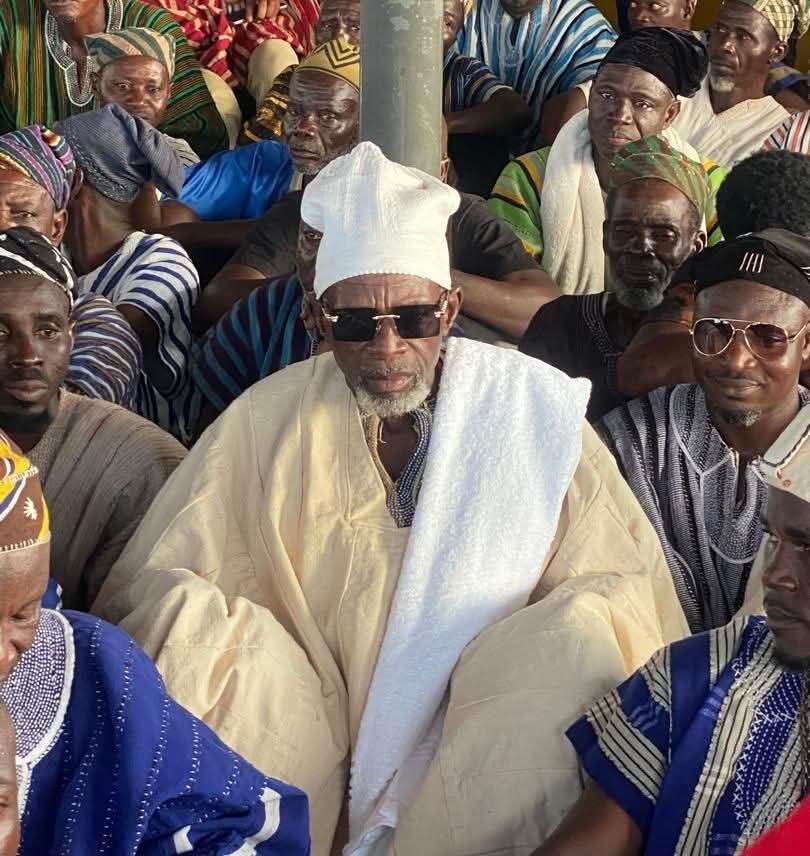
The Overlord and King of Dagbon, Yaa Naa Abukari II, has enskined Demong Kutun Lana, Alhassan Mahama, as the new Paramount Chief of Mion traditional area following the successful completion of the funeral rites of the late Mionlana Abdulai Mahamadu IV last Friday, May 30, 2025.
The Regent of Mionlana Abdulai IV, Naa Alhassan Tipariga, in the company elders of the Mion Palace on Tuesday, June 3, paid a royal visit to the Gbewaa Palace to formally inform the Yaa Naa about the completion of the funeral rites of the late Chief in line with the custom and tradition of Dagbon.
This would therefore pave the way for the kingmakers to nominate a new Chief to take over the skin. Consequently, Yaa Naa Abukari II offered cola to Naa Alhassan Mahama II, the first son of the late Yaa Naa Mahama Bila, as the new Mionlana.
He expected to perform the necessary rituals before his official unveiling in the coming days.
Background:
Mion-Lana Alhassan II was born in Yendi in January 1952. He is the biological son of Naa Mahama Bla (1948-1953) and Napaɣa Sanatu Paɣakaba.
Statistically, Mion-Lana Alhassan II is the fourth son of his father, Naa Mahama Bla. The first son (Zuu) of Naa Mahama Bla was Yaa-Naa Abdulai ŋmarigɔŋ (1954-1967). The second was Nasa-Lana Naantɔɣimah, followed by Nabiyɔŋ Suɣiri as the third son. Mion-Lana Alhassan II is the fourth son. Currently, the surviving princes of Naa Mahama Bla are three: Mion-Lana Alhassan II, Nabiyɔŋ Andani Mahama, and Nabiyɔŋ Ziŋ-Naa AlhassaAlhassan. The surviving princesses are four in number.
After the passing of his father in 1953, Mion-Lana Alhassan II and his mother, Napaɣa Sanatu Paɣakaba, were customarily sent back to her natal home—N Yaba Yiri—where they were cared for by his maternal family.
It will interest you to note that he is the only son of his mother, who hails from the renowned Achiri Damba’s lineage—a line distinguished for its warrior heritage and historical significance. Let us briefly trace this maternal descent:
The legendary warrior Achiri Damba—revered as “Sapaɣa yi dimma di so tinŋmari dimbu dama tinŋmari ka galiga” — fought alongside Kambon Nakpɛm Ziblim during the historic Battle of Adibo on 4th December, 1896. Achiri Damba gave birth to Kaluɣu Musah, who fathered Wumbei and Neindoo. This particular Wumbei begot Jahinfo Jɛrigu, who served as the Yani Jahinfo during the reign of Naa Abudu Satankuɣili (1920–1938). Jahinfo Jɛrigu fathered N Yaba Kojo, who in turn gave birth to N Yaba Yiri. N Yaba Yiri brought forth Napaɣa Sanatu Paɣakaba, the mother of Mion-Lana Alhassan II.
In 1960, at the age of eight, Mion-Lana Alhassan II began his formal education at Yendi Primary School. He later proceeded to Naa Yaakuba Middle School in 1967. In 1970, he gained admission into Yendi Secondary School as a pioneer student. Among his classmates were notable figures such as:
Naa Bapra Kpan-Naa Abukari Abdulai (Paramount Chief of Kpano Traditional Area)
The late Hon. Mustapha Ali (Former MP for Gukpegu-Sabonjida Constituency and Minister of Works and Housing under President Kufuor)
Dr. Abu Sakara (Former Flagbearer of the CPP)
Mr. Mumuni Mahama (Retired Educationist and former Director, Islamic Education Unit).
After completing his secondary education, Mion-Lana Alhassan II was employed as a pupil teacher in 1976. He initially taught at Zohe Experimental Primary School and was later transferred to Dimɔŋ Primary School, where he served for about two years.
In 1978, he transitioned into a new role when the Ministry of Food and Agriculture employed him as a Plant Quarantine Officer, with his first posting in Saboba. In 1988, he gained admission to the Agricultural College in Nyankpala, where he pursued a two-year diploma program. Upon completion in 1990, he was posted to Gambaga as a Plant Protection and Regulatory Service Officer. In 1999, he was transferred to Bunkpurugu as a Plant Quarantine Officer—a role in which he served with deep commitment and passion. Mion-Lana Alhassan II served diligently until his retirement on 1st February, 2013.
Mion-Lana Alhassan II is blessed with three wives, ten children(6 males & 4 females), and fifteen grandchildren, forming a close-knit and cherished extended family. May his reign as Mion-Lana be marked by wisdom, peace, and prosperity, and may he continue to serve his people with dignity and honor.
— 𝑾𝒓𝒊𝒕𝒕𝒆𝒏 𝒃𝒚 ʒ𝒊𝒊 𝑻𝒖𝒚𝒂 𝑵𝒂𝒂 𝑴𝒐𝒉𝒂𝒎𝒎𝒆𝒅 𝑩𝒂𝒃𝒂