

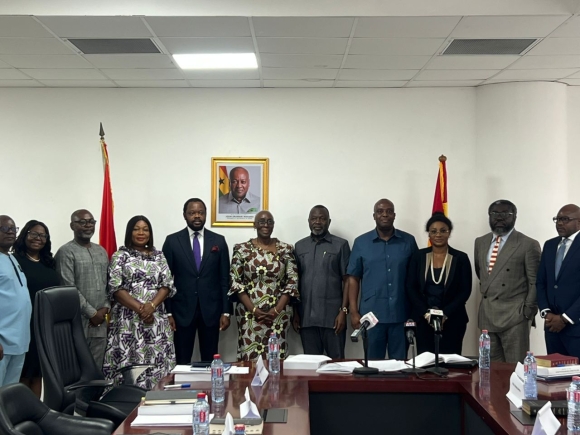
Attorney-General and Minister of Justice Dr Dominic Akuritinga Ayine has inaugurated an 11-member Constitution Review Implementation Committee (CRIC) to translate accepted recommendations on reforming Ghana’s 1992 Constitution into concrete laws and practical measures.
The committee was sworn into office on Friday, 28 August 2026, at the Law House in Accra. It is chaired by Presidential Legal Counsel and former Attorney-General Marietta Brew Appiah-Oppong.
Other members of the committee are:
- Dr Justice Srem-Sai (Deputy Attorney-General)
- Thomas Ampem Nyarko (Deputy Finance Minister)
- Charlotte Osei
- Dr Rainer Akumperigya
- Emelia Ankomah (Majority representative)
- Kwame Ayimadu Antwi (Minority representative)
- Samuel Passah (Local Government representative)
- Oliver Barker-Vormawor (Secretary)
- Salamatu Iliasu (Draftsperson)
- Eric Owusu-Mensa (Parliament’s representative)
Dr Ayine charged the committee with a clear and time-bound mandate. He directed that the first set of constitutional amendment Bills, particularly those dealing with non-entrenched provisions, should be ready for presentation to Parliament by November 2026.
He indicated that some of the proposed amendments would eventually be subjected to a referendum, potentially alongside the 2027 district assembly elections. “Your task is deliberately bipartisan and deliberately time-bound,” the Attorney-General told the members.
The inauguration follows the government’s publication of its position paper on the recommendations of the earlier Constitution Review Committee, which was chaired by Professor H. Kwesi Prempeh. The new body is expected to examine both the government’s position paper and the original review report, then develop a comprehensive framework for implementation.
Chairperson Marietta Brew clarified the committee’s limited but critical role. She stressed that the panel was not established to conduct another general review of the 1992 Constitution. Instead, its responsibility is to convert the recommendations already accepted by the government into lawful, coherent and practical measures.
“Our responsibility is to translate the recommendations accepted by government into lawful, coherent and practical measures capable of implementation,” she said.
Brew also assured that the committee would maintain comprehensive records of its decisions, activities and expenditure, prepare an implementation roadmap and legislative calendar, and report regularly on progress.
The establishment of the CRIC marks a significant step in Ghana’s ongoing constitutional reform process, moving the country from the review and consultation phase into the practical stage of drafting and enacting changes.