
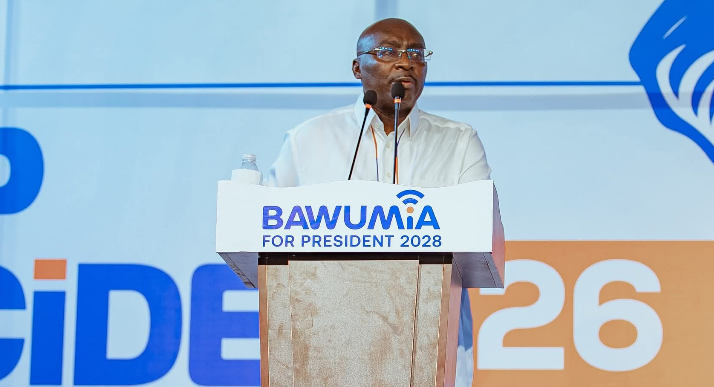
A nationwide voter perception survey by Africa Policy Lens (APL) has placed New Patriotic Party (NPP) flagbearer for the 2028 general election, Dr Mahamudu Bawumia ahead of seven potential National Democratic Congress (NDC) presidential contenders in hypothetical head-to-head contests.
The findings are contained in the first edition of the APL Election Outlook Series 2026, based on a survey conducted between July 27 and August 7, 2026.
According to the report, 16,963 respondents were interviewed through face-to-face engagements across all 276 constituencies in Ghana’s 16 regions.
APL said the survey was designed to achieve a 99% confidence level with a margin of error of ±1%.
The research assessed voter preferences in hypothetical presidential contests involving Dr Bawumia and seven potential NDC candidates, while also examining the leadership qualities voters consider important in choosing Ghana’s next President.
Bawumia leads across all seven matchups
The survey found that Dr Bawumia secured between 45.7% and 49.9% of voter support across the seven hypothetical contests.
In a matchup against former NDC General Secretary Johnson Asiedu Nketiah, Dr Bawumia obtained 45.8% compared with 42.4% for Mr Asiedu Nketiah.
About 7.2% of respondents were undecided, while 3.8% said they would vote for neither candidate.
Dr Bawumia also recorded a narrow lead over Finance Minister Dr Cassiel Ato Forson, receiving 45.7% compared with Dr Forson’s 42.8%.
Some 7.5% of respondents remained undecided.
The NPP candidate’s strongest margins were recorded against some of the other potential NDC contenders.
Against Food and Agriculture Minister Mr. Eric Opoku, Dr Bawumia polled 49.8%, compared with 33.9% for Mr Opoku. The survey recorded 9.3% undecided voters.
Dr Bawumia also led Vice President Prof. Naana Jane Opoku-Agyemang by 47.4% to 40.2%.
In another hypothetical contest, Dr Bawumia secured 48.4% against 37.9% for Chief of Staff Dr Julius Debrah.
He also led former Minority Leader and current Education Minister Haruna Iddrisu by 45.9% to 41.5%.
His widest reported advantage was against Prof. Joshua Alabi, where Dr Bawumia obtained 49.9% compared with 34.4% for the former University for Professional Studies, Accra Rector.
Character and economic management top voter priorities
Beyond candidate preferences, the survey examined the leadership qualities Ghanaian voters consider most important in the country’s next President.
APL reported that honesty and integrity ranked as the most important quality, followed by the ability to create jobs and competence in managing the economy.
The findings suggest that voters are likely to place significant emphasis on both personal character and economic performance as political parties and candidates prepare for the 2028 elections.
APL cautions against treating findings as election prediction
Despite the consistent lead recorded by Dr Bawumia, the research organisation cautioned that the results should not be interpreted as a prediction of the 2028 election outcome.
APL said the survey represents public opinion at the time the interviews were conducted, noting that voter preferences could change in response to political developments, economic conditions, government performance and campaign activities.
The organisation nevertheless described the consistency of Dr Bawumia’s advantage across all seven matchups as noteworthy.
According to the report, his lead across different hypothetical contests suggests that his current support is not limited to a particular potential opponent.
The survey also assessed the geographical spread of voter support and found that Dr Bawumia recorded victories in between nine and 11 of Ghana’s 16 regions across the different matchups.
Survey methodology
APL said the survey used a multistage probability sampling approach, with electoral areas selected based on the size of the registered voter population in each constituency.
Polling stations were subsequently selected randomly, while respondents were systematically interviewed using established sampling intervals.
The sample included people from different demographic and socioeconomic backgrounds, including farmers, traders, artisans, public servants, students, transport operators, unemployed persons and persons with disabilities.
APL said the sample size was determined using the 2024 Electoral Commission Voter Register, which recorded 18,774,159 registered voters.
The organisation said a minimum sample of 16,627 respondents was required to achieve the stated confidence level and margin of error, with the final number of respondents reaching 16,963.
Implications for the 2028 race
The findings provide an early indication of the political landscape as Ghana moves towards the next presidential election.
For the NPP, the results could be viewed as a positive signal for Dr Bawumia, who is seeking to lead the party back to power after its defeat in the 2024 presidential election.
For the NDC, the survey highlights the potential competitiveness of several figures but also points to the challenge of consolidating support around a candidate capable of matching Dr Bawumia nationally.
However, with the election still ahead and potential candidates yet to be formally selected by the NDC, the political landscape remains fluid.
APL itself noted that future developments could significantly alter voter preferences.
The organisation suggested that further research examining voter assessments of government performance, policy delivery and key national issues would help explain the factors behind the preferences recorded in the survey.
An early snapshot, not a verdict
The APL report ultimately presents Dr Bawumia as being in a favourable position against the potential NDC candidates tested.
However, the presence of sizeable undecided groups in several matchups indicates that the contest remains open. In the closest scenarios, the gap between Dr Bawumia and his potential NDC opponent is only a few percentage points.
With the 2028 election still ahead, the survey offers an early snapshot rather than a definitive verdict on Ghana’s next presidential race.
Political developments, economic conditions, government performance, candidate selection and campaign strategies are all likely to influence how voters make their final choices.