

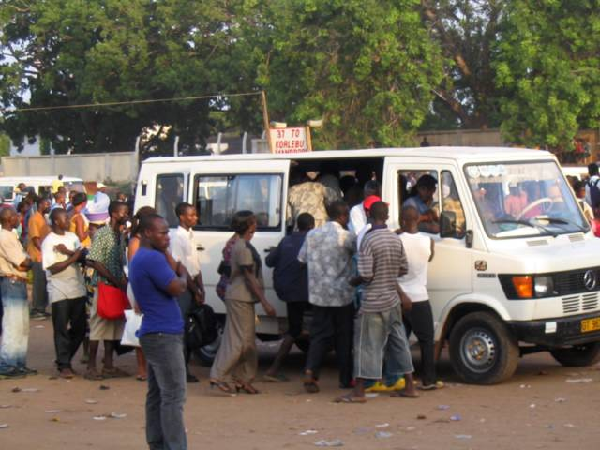
Commuters across Ghana’s major cities, specifically Accra, continue to risk their lives daily on run-down commercial vehicles, popularly known as trotros, despite a massive national push to sanitise the transport sector.
Recent provisional data from the National Road Safety Authority (NRSA) revealed a troubling reality: a staggering 2,949 people lost their lives in 14,743 road traffic crashes across Ghana in 2025, representing a 9.3% spike in accidents from the previous year. While speeding and human error remain leading causes, road safety experts point directly to the unchecked influx of poorly maintained, structurally compromised vehicles as a primary reason for the mounting body count.
The Living Nightmare of the Ghanaian Commuter
A visit to busy transport hubs like the Kwame Nkrumah Interchange and Madina Market station, among others, reveals the sheer scale of the crisis. Hundreds of commercial buses ply major highways with corroded body frames, exposed electrical wiring, and makeshift wooden or metal seats featuring sharp, protruding edges. Martha, a young woman who frequently shops at Madina Market, had this to say: “I live at Old Ashongman, and most of the trotros to the place are very bad. One had an almost flat tire but still loaded people onto it. It’s very serious.”
“Every time it rains, we get soaked inside the trotro because the roofs are completely rusted through,” says Madam Esinam, a daily commuter from Madina to Accra. “We complain bitterly because these metal shards tear our clothes and cut our skin, but we have no choice. The state transport alternatives are limited; ordering rides and taxis is too expensive.”
For drivers, however, the choice to operate these “death traps” is driven strictly by economic survival.
“We try our best when we are on the road because at the end of the day we need to provide for our families,” explains Ahmed Mohammed, a driver operating an old Mercedes-Benz van.
Some drivers also talk about the increasing prices of spare parts. They claim they have no choice but to use it because the spare parts are too expensive. “In this country, the cost of spare parts has always been on the rise. Even when we try to increase transporting wares, we are unable to do so. Where will we get the money to fix the cars?” A driver at the atomic station lamented.
The Toyota Voxy Crackdown
The conversation surrounding structural vehicle integrity reached a boiling point in early April 2026, when the NRSA National Road Safety Authority) officially banned the popular Toyota Voxy from long-distance commercial travel.
An investigation by an NRSA Technical Working Group revealed that these vehicles, originally manufactured as right-hand drive models for the Japanese domestic market, undergo informal, unregulated left-hand drive conversions upon arriving in Ghana. Regulators discovered that these local alterations severely compromise critical steering mechanisms and braking systems, turning them into high-speed liabilities on highways like the Accra-Kumasi road.
While the ban has faced fierce resistance from drivers, unions like the Ghana Private Road Transport Union (GPRTU), argue it is necessary to save lives.
New Laws, Weak Enforcement?
The persistence of these rickety vehicles comes at a time when Ghana has enacted its most stringent transport legislation in decades. Following the passage of the new Road Traffic Regulations (2026), the Driver and Vehicle Licensing Authority (DVLA) and Parliament introduced sweeping reforms.
The updated legislation imposes stricter mandates, requiring all commercial operators to belong to registered transport entities with established offices across all 16 regions. Furthermore, under the new regime, operating with faulty parts, worn-out tyres, or unauthorised vehicle modifications attracts heavy fines or prison sentences up to six months.
Yet, any commuter will tell you that the laws on paper do not match the reality on the asphalt. Critics accuse field officers from the Motor Transport and Traffic Department (MTTD) of the Ghana Police Service of turning a blind eye to obvious roadworthiness violations.
The Path Forward
The Ministry of Transport has hinted at plans to aggressively expand state-run fleets such as the Metro Mass Transit and STC, delivering the first batch of 100 vehicles to Metro Mass Transit in 2024 to offer commuters safer, viable alternatives and organically force unsafe vehicles out of business.
However, transport analysts argue that until the DVLA stamps out the use of unorthodox, corrupt means to acquire roadworthy certificates, these vehicles will continue to hunt for prey on Ghanaian roads. Insert DVLA persons. For now, millions of Ghanaians have no option but to, board a decaying trotro and hope they make it to their destination in one piece.
By: Kuukuwa A. Dadzie