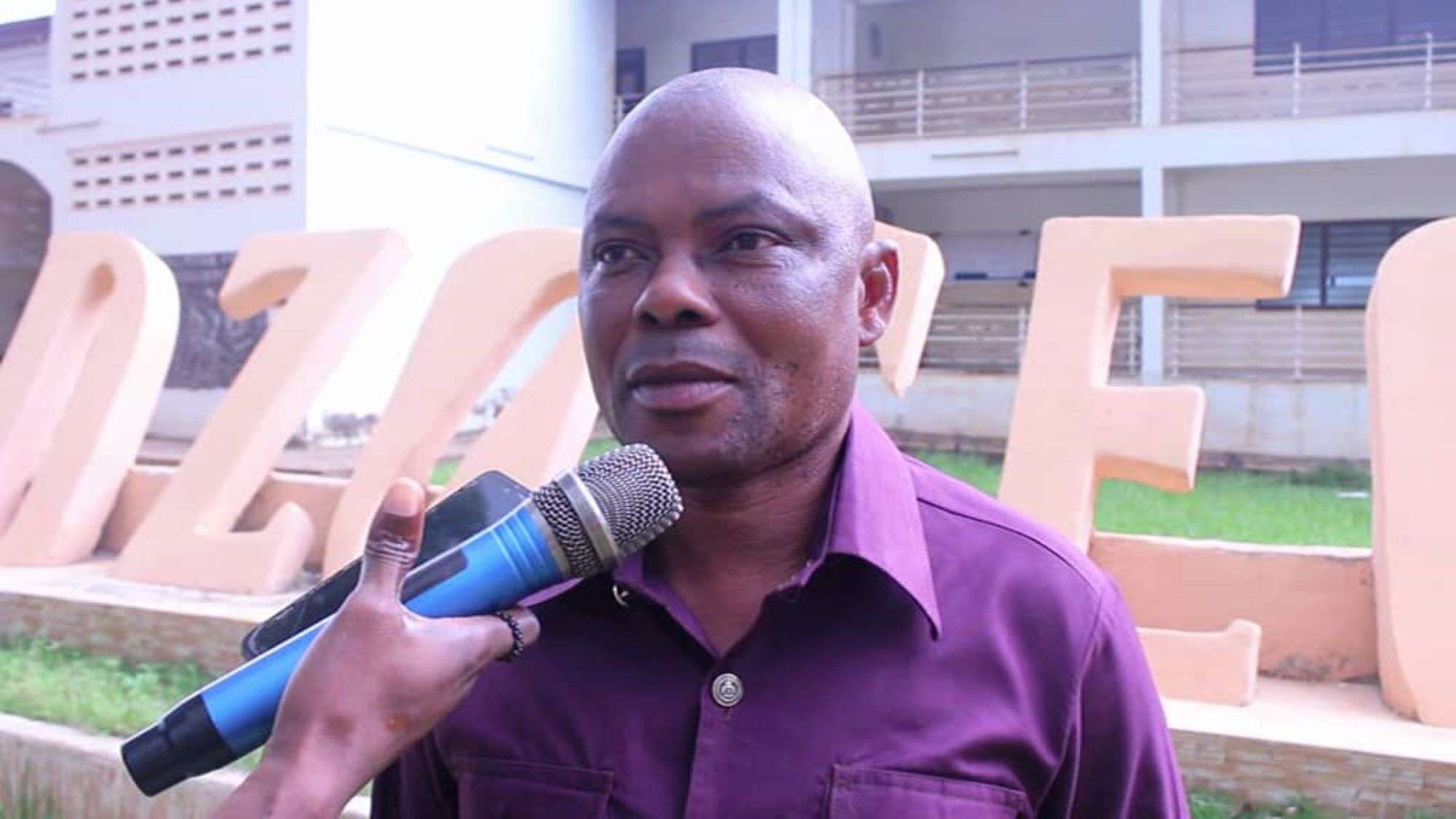

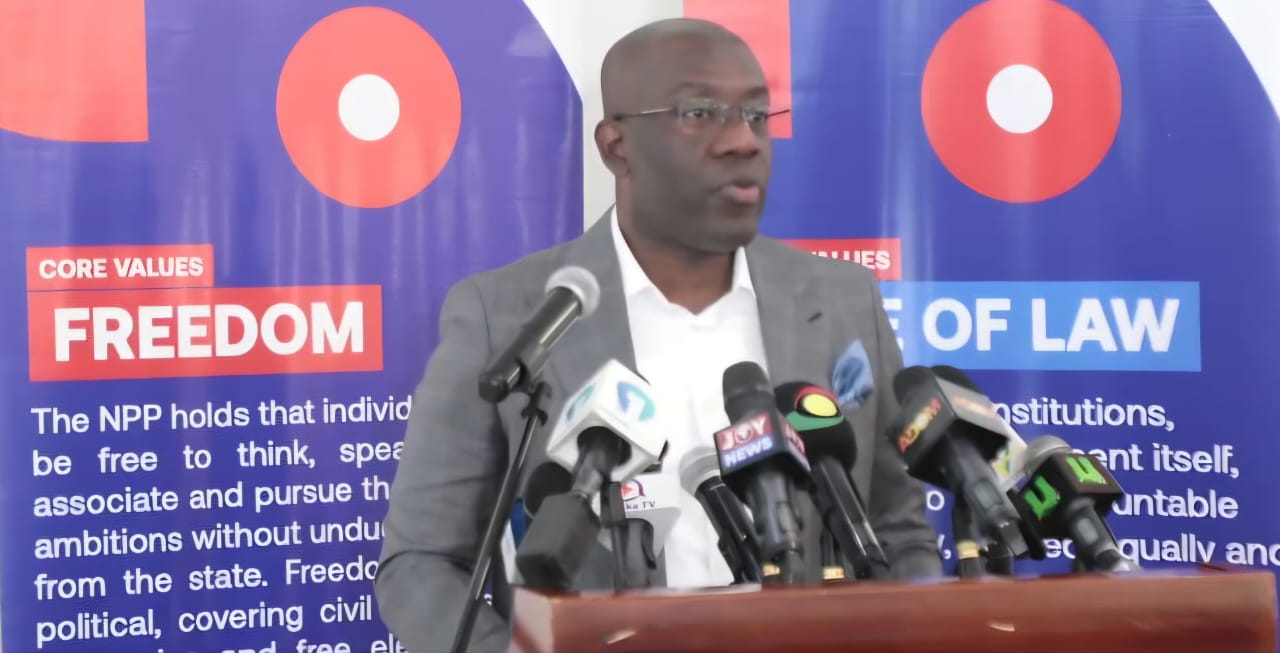
The Member of Parliament for Ofoase-Ayirebi and Ranking Member on Parliament’s Economy and Development Committee, Mr. Kojo Oppong Nkrumah, has called on the Minister for Finance, Dr Cassiel Ato Forson, to account for its existing economic promises and programmes before introducing what it described as the “New Economy.”
Mr Oppong Nkrumah said creating jobs, increasing domestic production, and reducing Ghana’s dependence on imports were desirable, but argued that the government must first show measurable results from the programmes it introduced after assuming office.
His comments come as Finance Minister Dr Cassiel Ato Forson engages stakeholders, including the Association of Ghana Industries, the Trade Ministry and the banking sector, on the government’s emerging economic strategy.
According to Mr Oppong Nkrumah, the full details of the New Economy are expected to be in the 2027 Budget.
He said while the government’s stated objective was not in dispute, the administration had already made several promises to Ghanaians that required proper accounting.
“I agree with that goal, and so would most Ghanaians,” Mr Oppong Nkrumah said, pointing to programmes such as One District One Factory and Planting for Food and Jobs as previous efforts aimed at increasing production and creating employment.
His concern, however, is that the current government also campaigned on a number of programmes that promised jobs, financing, agricultural transformation and industrial development, yet several of them, in his assessment, have not produced sufficiently verifiable results.
24-Hour Economy
Mr Oppong Nkrumah placed particular emphasis on the government’s flagship 24-Hour Economy Programme, which was presented as a major component of the NDC’s economic plan.
The programme promised to create 1.7 million decent jobs by the end of 2028, while its direct budget allocation for 2026 was stated as GH¢110 million.
The MP said when he sought information in July about what the programme had achieved, the Secretariat cited 268 filling stations and 33 manufacturers operating in shifts.
He questioned whether those figures could be used to demonstrate the impact of the programme, arguing that many filling stations were already operating at night before the current government took office.
He also questioned the reported 160,000 jobs linked to recently signed agreements.
Mr Oppong Nkrumah said the government should provide evidence of the workers, the companies employing them and SSNIT contributions being paid on their behalf.
“I described those numbers at the time as audio announcements, and I stand by it,” he said, arguing that employment figures should be independently verifiable.
Women’s Development Bank
The MP also questioned the implementation of the Women’s Development Bank, one of the prominent economic promises of the 2024 campaign.
He said the bank had not yet lent a single cedi despite the government allocating GH¢51.3 million in 2025 and several hundred million cedis in 2026.
He also cited the Finance Minister’s July statement that GH¢400 million had been deposited at the Bank of Ghana as capital.
However, Mr Oppong Nkrumah said the institution was incorporated only in January 2026 and was still awaiting a banking licence.
He said women’s groups, including NETRIGHT, had been calling on government to accelerate the process, while market women who expected access to cheaper financing continued to rely on susu collectors and moneylenders.
He therefore wants government to provide a firm date for the commencement of lending and publish the criteria that will govern access to the funds.
1 million Coders
Mr Oppong Nkrumah also raised questions about the One Million Coders Programme, which seeks to train one million young Ghanaians over four years and create pathways to employment and remote work.
The 2026 target was 300,000 participants.
By the mid-year review, the government had reported 140,000 registrations, 40,000 enrolments and about 28,000 people completing at least one module.
The MP argued that completing one module did not necessarily mean that a participant had become a coder or acquired employable skills.
He said the more important measure was how many trainees had secured employment, but noted that there was no published figure showing how many graduates had found jobs.
Feed Ghana and poultry programme
The Feed Ghana Programme, particularly its Nkoko Nkitinkiti poultry component, was another area of concern.
The programme was intended to increase domestic poultry production and reduce Ghana’s dependence on imported chicken.
Mr Oppong Nkrumah referred to comments made by the Agriculture Minister before Parliament’s Assurances Committee that some beneficiaries had consumed the birds instead of rearing them.
He also cited the Poultry Farmers Association, which described the first phase as an “abysmal failure” and said its offer to train beneficiaries for free had been ignored.
The Agriculture Minister, however, maintains that the programme is successful and has pointed to falling poultry prices.
Mr Oppong Nkrumah said government should publish figures showing how many beneficiaries remain in production and whether the programme has reduced poultry imports.
He also raised concerns about the cattle, goat, sheep and pig components of Feed Ghana, saying government had confirmed that those components had not yet started.
Cocoa price promise
Mr Oppong Nkrumah also raised concerns about the government’s commitments to cocoa farmers.
He referred to the earlier GH¢6,000 cocoa price promise, arguing that the figure has subsequently been reduced.
He said cocoa farmers deserve an explanation of what was promised, what has been delivered and what has changed.
For him, accountability should include promises made to farmers and other productive sectors, not only large government programmes.
Questioning the “New Economy”
The MP further questioned whether the New Economy represents a genuinely new policy direction or largely repackages programmes already announced.
According to his statement, the New Economy could involve about US$10 billion over four years for commercial agriculture, mining value addition, energy and transport infrastructure.
Mr Oppong Nkrumah noted that commercial agriculture already forms part of Feed Ghana, while agro-processing and energy projects are also associated with the 24-Hour Economy.
He further pointed out that access to finance for small producers was a key purpose of the Women’s Development Bank.
He therefore argued that government should first demonstrate measurable achievements under its existing programmes before presenting another framework as a new economic solution.
Who should take credit for economic stability?
Mr Oppong Nkrumah also challenged the government’s claims about recent improvements in inflation, the cedi and investor confidence.
He recalled that the NDC had campaigned on renegotiating Ghana’s IMF programme while in opposition, with then-candidate John Mahama indicating in 2024 that he would pursue such a move.
After assuming office, however, the Finance Minister explained that renegotiating the programme could suggest that government did not believe in its parameters, and the proposal was dropped.
Mr Oppong Nkrumah argued that the government should therefore distinguish between economic improvements resulting from inherited policies and outcomes directly produced by its own programmes.
He defended the previous NPP administration’s role in the recovery, citing the IMF programme secured in May 2023, the domestic debt exchange, the June 2024 agreement with bilateral and commercial creditors and the Eurobond exchange.
He said inflation had fallen from 54.1 percent at the end of 2022 to 23.8 percent, while the economy grew 5.7 percent in 2024.
Fiscal discipline and debt
Mr Oppong Nkrumah also questioned the proposed reduction of the primary balance floor from 1.5 percent of GDP to 0.5 percent from 2027.
He said the IMF had indicated that Ghana could meet its debt targets under the lower fiscal path, but only if revenue mobilisation, public investment management and the finances of state-owned enterprises, particularly in energy and cocoa, improve.
He also highlighted GH¢58 billion in restructured domestic bonds due in 2027 and another GH¢53 billion due in 2028, arguing that Parliament must understand how the government intends to finance its new economic ambitions while meeting these obligations.
What Parliament should demand
The Ofoase-Ayirebi MP has called for greater parliamentary scrutiny of the New Economy.
He wants government to publish a verifiable register of jobs attributed to the 24-Hour Economy, with figures capable of being checked against payroll and SSNIT records.
He also wants a firm date for the Women’s Development Bank to begin lending and the publication of its lending criteria.
For the One Million Coders Programme, he wants government to disclose how many graduates have secured employment.
He has further called for an independent audit of Nkoko Nkitinkiti beneficiaries to establish how many remain in poultry production.
Before Parliament considers changes to the fiscal responsibility framework, he wants the Finance Minister to present a costed plan for the 2027 and 2028 debt maturities, evidence of progress on IMF-identified reforms and audited reporting on the use of any additional fiscal space created.
Mr Oppong Nkrumah maintained that Parliament should not weaken the country’s fiscal anchor to finance a programme whose full details have not yet been published.
He concluded that Ghanaians voted in 2024 based on promises of jobs, economic relief and specific government programmes, and that those commitments remain subject to public accountability.
“The promises made in 2024 have not expired, and the government should be held to every one of them,” he said.