

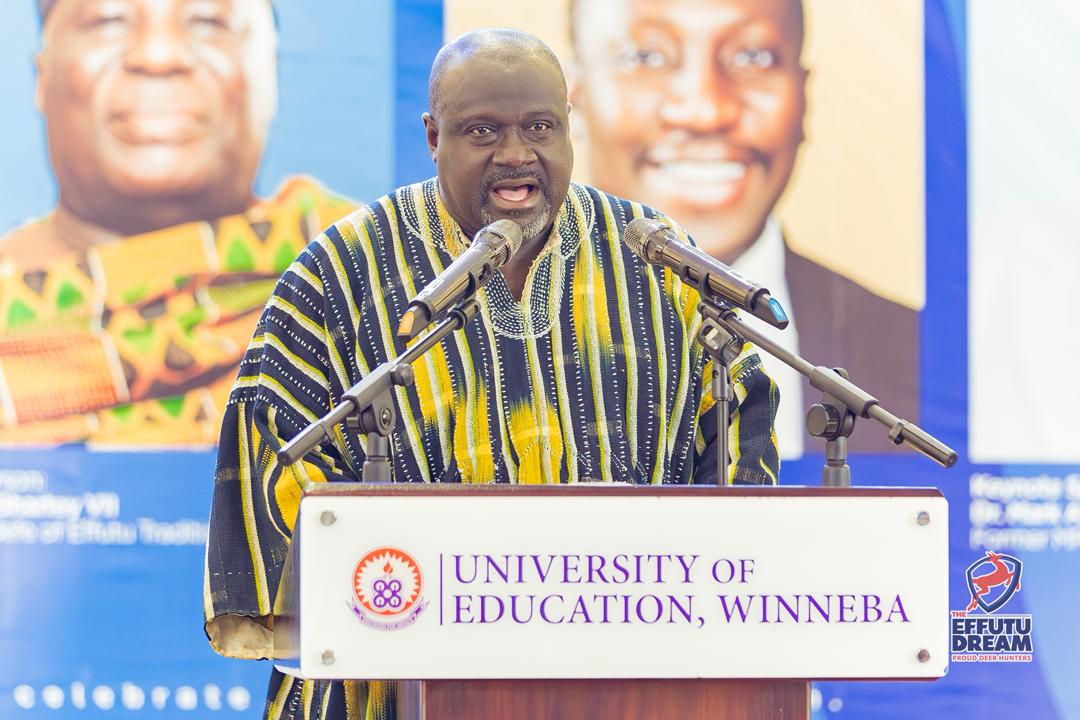
A renowned economist and former Member of Parliament (MP) New Juaben South, Dr. Mark Assibey-Yeboah, has extolled the personal and professional journey of Minority Leader Osahen Alexander Afenyo-Markin, describing it as a story of resilience and determination.
He recounted how the Minority Leader who is also the MP for Effutu rose from humble beginnings, including selling bread as a child to support his family, before pursuing education and building a career in law, business, and politics.
According to him, Osahen Afenyo-Markin’s rise to prominence in Ghana’s Parliament reflects not only personal ambition but also a commitment to public service and institutional development.
Dr Assibey-Yeboah further highlighted the contributions of the Minority Leader to parliamentary oversight, advocacy for transparency in resource management, and efforts to strengthen democratic governance structures.
The former MP and Chairman of Finance Committee of Parliament eulogised the Minority leader during a public lecture held at the University of Education, Winneba, on the theme “Selfless Leadership and Public Service: Building Integrity, Trust and Accountability.”
The lecture was organised in honour of the Minority Leader as a recognition of his public service and leadership journey.
The event was convened by the Effutu Traditional Council in partnership with Christian and Muslim communities, and brought together traditional rulers, clergy, MPs, academics, and students in a discussion on leadership, governance, and national values.
Importance of culture identity
The lecture further underscored the importance of cultural identity in shaping leadership values.
Dr. Assibey-Yeboah praised the Effutu Traditional Council and highlighted the significance of the Aboakyer Festival as a symbol of unity, history, and continuity within the Effutu State.
He referenced a statement attributed to Osahen Afenyo-Markin, saying, “Culture gives aspiration while history gives inspiration,” to emphasise the role of tradition in shaping modern leadership ideals.
Dr. Assibey-Yeboah urged young people in attendance to focus not only on academic achievement but also on character formation, discipline, and a commitment to public service. He cautioned that education alone is insufficient to transform society if it is not accompanied by integrity and ethical responsibility.
“Society does not become better simply because educated people exist. Society becomes better when educated people develop character, discipline, integrity, and commitment to service,” he stated.
Dr. Assibey-Yeboah further encouraged the youth to prioritise long-term impact over short-term recognition, warning against the pursuit of popularity and material success at the expense of ethical standards and community development.
Call for selfless service
Dr. Assibey-Yeboah called on Ghanaian leaders and citizens to renew their commitment to selfless service, integrity, and accountability in public life, stressing that national development depends on ethical leadership and responsible citizenship.
He pointed out that growing public dissatisfaction with political leadership across Africa is largely driven by perceptions of self-interest, weak accountability systems, and declining trust in public institutions.
According to him, trust remains the most essential currency in governance and cannot be replaced by policy rhetoric or institutional design alone.
“Leadership is not about occupying office; it is about stewardship. True leadership demands restraint in moments of power, courage in moments of difficulty, humility in success, and integrity in temptation,” Dr. Assibey-Yeboah emphasised.
He stressed that public office holders must view leadership as a responsibility to serve others rather than a privilege for personal gain, adding that sustainable development is only possible when leaders act with discipline and accountability.
Dr. Assibey-Yeboah called for unity among citizens, stronger institutions, and a renewed national commitment to ethical governance, emphasising that sustainable national progress depends on building systems and values that outlast individuals, urging leaders at all levels to act in the collective interest of society.